Got a DDoS Ransom Note? Verify the Threat Before the Deadline


A DDoS ransom note tests an assumption most organizations have never checked: that the protection they have configured will hold when someone aims real traffic at it. The note itself proves very little. It does not show that the sender can carry out the attack, and it does not show that your defenses would stop it if they did.
Before the deadline, preserve the message, check for evidence of a demonstration attack, review network and application telemetry, and confirm that your DDoS protection covers every critical service. Do not pay the ransom, and do not wait for definitive proof before preparing your defenses.
This article covers the window between the note and the deadline. If traffic is already hitting your services, go straight to what to do during a DDoS attack, or bring in Red Button’s DDoS incident response team.
Some DDoS extortion threats are bluffs. Others are followed by real attacks, sometimes before the stated deadline. The priority is to establish what the evidence actually shows and to reduce your organization’s exposure while there is still time to act.
Is the DDoS Ransom Threat Real or a Bluff?
A DDoS ransom note, also referred to as a ransom DDoS (RDoS) threat, typically demands payment in exchange for not disrupting an organization’s internet-facing services. The message may specify a deadline, threaten a particular attack volume, or claim affiliation with a well-known group.
None of these details independently establishes credibility.
Attackers can impersonate established groups, collect publicly available infrastructure information, or exaggerate their capabilities. A specific IP address, or a claim of being able to launch a 1 Tbps attack, does not prove that the sender controls the resources required.
A demonstration attack provides stronger evidence. Some extortionists launch a short DDoS attack before or alongside their demand to show what they can do. However, even a confirmed attack does not prove that the sender can sustain the larger or longer assault described in the note.
The reverse is equally important: the absence of an observed demonstration attack does not mean the threat is harmless.
Rather than treating credibility as a yes-or-no question, separate the attacker’s claims from independently verified observations, and assess the potential impact on your services.
How to Verify a DDoS Ransom Threat
Verification should focus on operational evidence, not on the wording of the extortion email. Your security team needs to establish whether suspicious activity occurred, what it targeted, and whether the existing protection handled it.
Check for a Demonstration Attack
Start by examining the period around the note’s arrival, particularly if the sender claims to have run a demonstration.
Look for unusual bandwidth consumption, packet-rate increases, connection spikes, unexpected HTTP request volumes, or temporary service degradation. Depending on the attack vector, evidence may appear in network flow records, firewall telemetry, WAF events, CDN analytics, or application monitoring.
Pay attention to short-lived anomalies. A brief attack may be visible in detailed security events but barely noticeable in traffic graphs aggregated over longer intervals.
Do not assume every spike is malicious. Legitimate traffic surges, application faults, and configuration changes can produce similar symptoms. Correlate suspicious patterns with service-health metrics and with the timing of the alleged attack.
Correlate Network, CDN and Application Evidence
One of the most common verification mistakes is relying only on origin-server logs.
If a CDN, ISP, or DDoS mitigation provider filters malicious traffic upstream, the origin may never see it. Normal server logs can coexist with a genuine, successfully mitigated attack.
Ask your providers to review their own telemetry, including attacks blocked before traffic reached your infrastructure. Examine both network-layer and application-layer events where relevant.
Use the following evidence matrix to keep your conclusions proportionate to the data you have:
Evidence | What it can establish | What it cannot prove |
Ransom email and headers | The sender’s claims, delivery information, targets and deadline | The sender’s identity or attack capability |
Unusual traffic patterns | Possible attack activity against specific services | That the extortionist caused it |
Confirmed demonstration attack | A demonstrated ability to generate malicious traffic | The scale or duration of a future attack |
Normal origin logs | No detected anomaly at that monitoring point | That upstream systems saw no attack |
Mitigation-provider events | Whether suspicious traffic was detected or blocked | That every exposed service is protected |
The distinction matters: verifying an attack is not the same as verifying the attacker.
The UK National Cyber Security Centre’s minimal denial of service response plan makes the same point: gather data from as many sources as possible, including monitoring across all system components, and consider non-malicious reasons why a system may have slowed down or stopped.
Five Steps Before the Deadline
The deadline is designed to create pressure. Treat it as a reason to accelerate defensive preparation, not as a reliable indication of when an attack will begin.
- Preserve the evidence. Save the original ransom message, complete email headers, timestamps, cryptocurrency wallet addresses, threatened targets, and any later communications. Preserve relevant logs securely, and do not open unsolicited files presented as proof of the attack.
- Assign an incident owner. Notify your SOC or NOC, name one person who owns the response, and involve the relevant infrastructure, management, and legal teams. Avoid uncoordinated communication or negotiation with the sender.
- Verify protection coverage. Identify critical internet-facing assets, including public websites, APIs, authoritative DNS, VPN endpoints and origin infrastructure. Confirm which assets are actually protected and whether any traffic can bypass the mitigation layer.
- Coordinate with upstream providers. Inform your ISP, hosting provider, and DDoS mitigation provider. Confirm that monitoring, traffic diversion, and escalation procedures work, including any manual activation requirements.
- Prepare for service disruption. Review alert thresholds, alternative communication channels, response responsibilities and fallback arrangements. Assess any emergency change to WAF rules, rate limits, or traffic routing for its effect on legitimate users.
These actions should begin even if the ransom note remains unverified.
When the Attack Arrives Before the Deadline: A Red Button Case Study
A Latin American financial conglomerate, including a bank and several financial companies, received an email demanding payment in Bitcoin and threatening a DDoS attack if the money did not arrive within one week.
The first attack arrived that same day.
It was a 60 Gbps UDP reflection attack. The organization had DDoS mitigation in place, but several network segments were not yet protected. Their links saturated, and services were disrupted for 15 minutes.
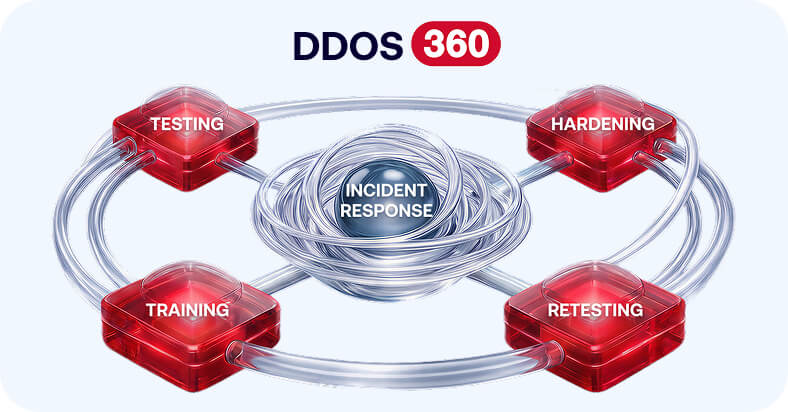
The company brought in Red Button’s Incident Response team. Within hours, a controlled DDoS simulation exposed problems in the infrastructure and in traffic routing. A repeat simulation the next day confirmed the routing fixes held, and a later application-layer simulation found further configuration gaps, which were then closed.
The second attack was nearly identical: 60 Gbps, sustained for 24 hours. This time there was no service disruption.
The lesson is not only that attackers may strike early. Having DDoS protection deployed does not mean every critical traffic path is protected.
Read the full ransom-driven DDoS attack case study.
Should You Pay a DDoS Ransom?
No. Paying a DDoS ransom provides no reliable guarantee that an attack will be prevented, stopped, or not repeated.
Payment also signals a willingness to comply with extortion demands, which may encourage further attempts. The sender may lack the promised capability, or may keep attacking after receiving payment.
Instead, concentrate resources on verifying the available evidence, securing exposed services, and preparing for potential disruption.
What If the Deadline Passes Without an Attack?
If the deadline expires and no attack is detected, the threat remains unverified rather than disproved.
The sender may abandon the attempt, issue another demand, or attack later. Malicious traffic may also have been blocked by an upstream provider without producing a visible service interruption.
Keep monitoring for delayed attacks, changing traffic patterns, and attempts against other exposed assets. Retain the evidence, and document the findings and decisions made during the response.
Use the incident to examine any protection gaps identified during verification. A quiet deadline is not a substitute for confirming that your infrastructure can withstand an attack.
Verify Your DDoS Readiness Before an Attack
A ransom note raises an uncomfortable question: would your existing DDoS defenses actually protect your critical services if the attacker followed through?
Security dashboards and deployed mitigation products cannot answer that question on their own. Misconfigured rules, unprotected network segments, routing problems, and application-layer weaknesses can stay hidden until attack traffic reaches vulnerable infrastructure.
Red Button’s DDoS testing uses controlled, authorized attack simulations to show how your protection behaves under realistic conditions. The findings help organizations identify gaps, prioritize remediation, and validate the fixes.
If your organization is facing an immediate threat, Red Button’s DDoS incident response specialists can help assess the situation, coordinate defensive measures, and prepare for a possible attack.
Do not let the attacker’s deadline become the first real test of your DDoS protection.
About the author