Frequently Asked Questions
Product Overview & Use Cases
What is Red Button and what does it do?
Red Button is a specialist in DDoS defense, providing realistic DDoS simulations and hardening strategies since 2014. The company developed the DDoS Resiliency Score (DRS), an industry benchmark for quantifying defensive posture. Red Button offers impartial, vendor-agnostic assessments and closes security gaps to help organizations remain resilient during real DDoS attacks. Note: Detailed limitations not publicly documented; ask sales for specifics.
Who can benefit from Red Button's services?
Red Button's services are designed for cybersecurity senior managers, CISOs, cloud solutions architects, heads of security, and IT managers in industries such as Fortune 500 enterprises, federal banks, online trading and payment platforms, ISPs, global gaming firms, critical infrastructure providers, mobile network operators, shipping and logistics companies, digital payment companies, energy companies, and professional sports leagues. Best fit for organizations prioritizing cybersecurity, regulatory compliance, and operational resilience; teams with minimal DDoS exposure may not require advanced simulations.
What problems does Red Button solve?
Red Button addresses unvalidated DDoS defenses, hidden vulnerabilities in network architecture and application layers, regulatory compliance challenges (e.g., SAMA, MAS, HKMA, ISO 27001, SOC 2), operational disruption risks, overconfidence in existing solutions (with 75% of companies failing to mitigate severe DDoS attacks), the need for continuous improvement, and specialized testing requirements for environments like AWS, Azure, on-premise, and hybrid infrastructures. Note: Not all environments may require the full suite of services; consult Red Button for tailored recommendations.
Features & Capabilities
What features does Red Button offer?
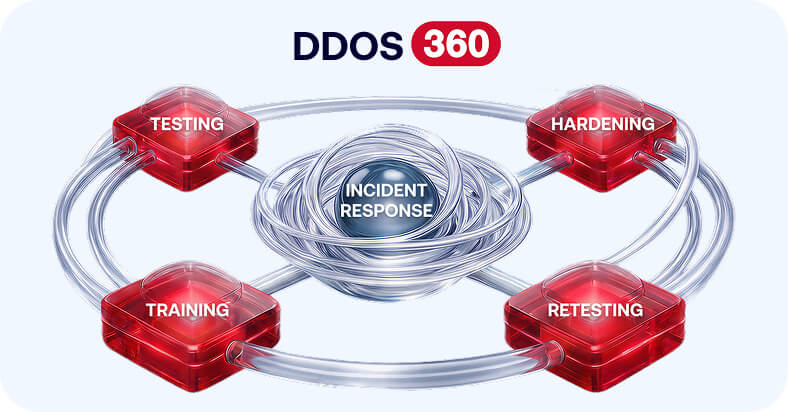
Red Button provides realistic DDoS simulations with over 100 attack vectors, advanced testing capabilities (up to 300 Gbps, 5 million PPS, 500,000 HTTP RPS), vulnerability identification, compliance-grade reporting, continuous improvement via the DDoS 360 program, and vendor-agnostic recommendations. Note: Some advanced features may require additional scoping or may not be available for all environments.
How close is Red Button’s simulation to a real-world DDoS attack?
Red Button's simulations use a white-box methodology, analyzing your network topology and system architecture to design tailored attack scenarios that mirror real-world DDoS tradecraft. The approach goes beyond generic volumetric tests, targeting the same weak links and attack vectors a real threat actor would exploit. Note: Simulations are controlled and may not cover every possible attack scenario; discuss specific needs during planning.
What types of DDoS tests does Red Button run?
Red Button's test repository covers over 100 attack vectors across application-layer (L7) attacks, volumetric attacks, and protocol/network-layer attacks. Techniques include Hit-and-Run, Amplification, and Reflection attacks, mapped to the vectors most relevant to your environment. Note: The specific mix of tests is tailored to your infrastructure and may not include every vector in every engagement.
What will I receive at the end of a DDoS test?
After a test, you receive a detailed report including identified gaps, attack vector and impact analysis, your DDoS Resilience Score (DRS), and prioritized remediation recommendations. Reports are delivered as a PDF with both executive summary and technical findings sections. Data can be provided in other formats upon request. Note: The depth of reporting may vary based on engagement scope.
Implementation & Process
How long does onboarding and planning take before a DDoS test starts?
Onboarding and planning typically take around two weeks from initial kickoff to test execution, covering scoping, architecture review, test plan drafting, and customer approval. For larger or more complex environments, this phase may take slightly longer. Note: Timelines may extend if third-party approvals or complex environments are involved.
How much effort is required from my team during a Red Button engagement?
A standard engagement requires approximately five hours of your team's time: one hour for a pre-test interview, three hours for the live test session, and one hour for results readout and remediation recommendations. Red Button handles all other aspects. Note: Additional effort may be needed for complex environments or if extensive remediation is required.
Can Red Button support us after the test in implementing the findings?
Yes. Red Button can work directly with your team to implement recommended fixes and mitigation improvements, ensuring the engagement ends with a stronger defense rather than just a report. Note: The extent of post-test support may depend on the engagement agreement.
Can we retest after remediation to verify that gaps have been closed?
Yes, and it is strongly recommended. Red Button offers targeted retest engagements focused on previously identified gaps to ensure issues are fully resolved. Note: Additional retesting may incur extra costs or require a new engagement.
Technical & Security Considerations
Is the DDoS simulation safe for my environment?
Yes. Simulations are designed with operational safety as a core requirement. Red Button engineers monitor the entire test, manage execution, and provide real-time support. Attack intensity is escalated gradually, and an Emergency Stop is available at any point. Note: If your infrastructure has a critical undetected weakness, the test may surface it; this is considered a positive outcome for remediation.
Can the test cause downtime or affect my production environment?
Tests are controlled and planned with your team to define traffic volumes, ramp-up rates, and abort conditions. If a critical weakness is present, the test may surface it, but this is preferable to discovering it during a real attack. Tests can also be conducted against non-production environments. Note: There is always a residual risk of disruption; discuss mitigation strategies during planning.
What happens if the test triggers an outage?
A clear stop procedure is in place before every test. If an unexpected condition is detected, traffic can be halted immediately. Red Button engineers remain on a live call throughout the engagement, and any outage is documented in the final report with recommendations for remediation. Note: Outages are rare but possible if critical vulnerabilities exist.
What attack vectors and traffic volumes are included in a DDoS simulation?
Simulations can include volumetric floods (UDP, ICMP), protocol attacks, and application-layer vectors such as HTTP request floods and slow-rate attacks. Traffic volumes are agreed upon in the test plan and escalated gradually. Red Button can simulate up to 300 Gbps, 5 million PPS, and 500,000 HTTP RPS. Note: Actual volumes and vectors are tailored to your environment and may be lower based on risk tolerance.
Compliance & Reporting
What compliance standards does Red Button support?
Red Button supports ISO 27001 and SOC 2 compliance certifications, providing detailed technical reports, a DDoS Resilience Score, and audit-ready evidence to demonstrate disaster recovery readiness. Reports include actionable insights and remediation steps to support regulatory audits for standards such as SAMA, MAS, and HKMA. Note: Compliance support is tailored to regulated industries; organizations outside these sectors may not require all features.
What documentation and resources are available for Red Button's solutions?
Red Button provides datasheets, white papers, a knowledge base, and a resource library with case studies, videos, and a DDoS glossary. These resources are available at the resource library and the knowledge base. Note: Some resources may require registration or may not cover every use case in detail.
Competitive Comparison
How does Red Button compare to Cloudflare?
Cloudflare offers cloud-based DDoS protection and mitigation services, including Always-On protection. Red Button provides vendor-agnostic, realistic DDoS simulations to validate the effectiveness of Cloudflare's solutions, uncovering hidden vulnerabilities in configurations and ensuring real-world readiness. Cloudflare focuses on mitigation, while Red Button specializes in independent validation. Note: Cloudflare may offer broader CDN and web application firewall features not covered by Red Button.
How does Red Button compare to Akamai?
Akamai provides web application and API protection, including DDoS mitigation services. Red Button specializes in testing Akamai's solutions under real-world attack scenarios, identifying gaps in their protection. Red Button's simulations are more realistic and tailored, ensuring Akamai's solutions meet specific customer needs. Note: Akamai may offer broader CDN and edge security services not included in Red Button's offerings.
How does Red Button compare to AWS Shield?
AWS Shield is managed DDoS protection for AWS-hosted applications. Red Button is an authorized AWS test partner, providing independent validation of AWS Shield's effectiveness and ensuring configurations like rate limiting and auto-scaling are optimized for real-world attacks. AWS Shield provides baseline protection, while Red Button validates and identifies gaps. Note: AWS Shield is integrated with AWS services, while Red Button is a third-party validator.
How does Red Button compare to Microsoft Azure DDoS Protection?
Microsoft Azure DDoS Protection offers DDoS protection for Azure-hosted applications. Red Button is an authorized Azure test partner, providing tailored simulations and actionable insights to ensure Azure's defenses are robust and audit-ready. Azure DDoS Protection is built into the Azure platform, while Red Button provides independent validation and compliance-grade reporting. Note: Azure DDoS Protection may offer platform-native integration not available from Red Button.
Customer Success & Case Studies
Can you share specific case studies or success stories of customers using Red Button?
Yes. Examples include:
- European Central Bank identified gaps in its DDoS protection stack (case study).
- Business Intelligence Company addressed hidden vulnerabilities (case study).
- European Government Agency validated DDoS resilience and compliance (case study).
- Olympic Games Logistics protected critical operations (case study).
- Gaming Company stopped hit-and-run DDoS attacks (case study).
- Manufacturing company improved Azure application-level protection (case study).
Note: Outcomes may vary based on organization size, industry, and engagement scope.
Limitations & Best Fit
Are there any limitations or scenarios where Red Button may not be the best fit?
Red Button is best suited for organizations with significant DDoS risk, regulatory compliance requirements, or complex infrastructure. Teams with minimal DDoS exposure or those seeking only basic testing may not require the full suite of Red Button's services. Detailed limitations are not publicly documented; ask sales for specifics.