


DDoS Testing Tools: How to Choose a Test That Proves Your Defenses Work


A practical guide for security teams comparing free tools, self-service platforms, and expert-led testing
DDoS testing tools range from free traffic generators to self-service platforms and expert-led simulations. The right choice is not the tool that can simulate DDoS attack traffic at the highest volume, but the one that produces credible evidence about the risks your organization actually faces, and that your cloud provider permits you to run.
Most comparisons rank options by peak bandwidth, vector count, or price, as though the goal were to generate the largest possible attack. The goal is to answer a question: whether a component can withstand load, whether a security control triggers as expected, or whether the entire defense chain (CDN, WAF, ISP, scrubbing provider and origin) can detect, mitigate and recover from a realistic attack.
If you are deciding whether a free tool, a self-service platform, or a managed test can give your team the assurance it needs, talk to a Red Button DDoS expert before you test production.
Key Takeaways
- Choose by evidence, not volume.
Judge relevance, realism, control, and actionability before comparing bandwidth or vector count. - Match the method to the question.
Open-source tools, load tests, self-service platforms and managed simulations all have legitimate but different uses. - Check what your cloud provider allows first.
AWS and Azure only let approved partners simulate DDoS attack traffic, and only within published limits. - Measure the whole defense chain.
A useful test records detection, mitigation, legitimate-user impact, and recovery, not only whether the service stayed online.
The Most Dangerous DDoS Test Is One That Passes for the Wrong Reason
A clean test report feels reassuring. It only proves that your defenses handled the targets, traffic patterns, and attack vectors included in that specific test. If those conditions do not represent your real exposure, a passing result creates confidence without validating anything that matters.
A simulation aimed at your primary domain does not validate a business-critical API, subdomain, or origin server that follows a different traffic route. Volumetric traffic at Layer 3 and Layer 4 says nothing about how your application layer behaves. Traffic from a handful of IP addresses may trigger controls that would respond completely differently to a geographically distributed botnet, a limitation examined in Red Button’s review of common DDoS testing misconceptions. And a test that records only whether the service stayed online has not measured detection time, mitigation time, or how many legitimate users were blocked while the attack was under way.
This is the clean-report problem: a test passes because it challenged what the organization already protects well, while the assumptions that actually carry risk went untested. Before selecting a tool, decide what a successful result would need to prove.
The mistake Red Button’s testers see more than any other is not a missing product – it is a rate-limit rule that never fires. The rule exists, and the dashboard shows it, but the threshold sits above what a distributed botnet produces per client, or the scope does not match the endpoint under attack, or the rule was left in alert mode and never promoted to block. Red Button finds this pattern in roughly half of first tests, across every major vendor. Teams miss it because nothing looks broken until something tries to trigger it.
Denial of Service Testing Tools: What Each Category Actually Validates
People discuss DDoS testing tools as though they were one category. In practice, there are seven, and denial of service testing means something different in each.
|
Category |
Examples |
What it validates |
|
Packet crafting |
hping3, Scapy |
Firewall and ACL behavior against defined traffic, single source |
|
Open-source flooders |
LOIC, HOIC, Slowloris, GoldenEye |
Single-vector behavior in a laboratory environment |
|
Load and performance testing |
JMeter, k6, Locust, Gatling, Artillery |
Application capacity under expected user load |
|
Traffic generators and appliances |
Cisco TRex, Keysight BreakingPoint and CyPerf |
Lab-grade throughput and vector generation |
|
Self-service or guided testing platforms |
RedWolf |
Operator-run simulation within the platform’s scenario library |
|
Continuous automated testing |
MazeBolt RADAR |
Non-disruptive detection of configuration drift between tests |
|
Expert-led managed testing |
Red Button, NCC Group, NimbusDDOS, Safedash Analytics |
Controlled, multi-vector simulation at agreed traffic levels, with analysis and remediation |
Disclosure: Red Button provides expert-led managed DDoS testing and is included in this comparison.
No category is inherently better than the others. A packet generator is the right tool for verifying a firewall rule and the wrong tool for validating a scrubbing provider. A continuous automated platform catches drift between tests and, by design, will not tell you what happens under sustained load. The comparison that matters is between the question you need answered and what the category can establish.
Is hping Still Useful in 2026?
hping is an open-source packet generator and analyzer for TCP/IP, created by Salvatore Sanfilippo. It still ships with Kali Linux, and its author devised the idle-scan technique in 1998, seven years before hping3 existed; Nmap later implemented it. It is also more than twenty years old: the current release, hping3, dates from November 2005, and the project is no longer actively developed.
That does not make it obsolete. For an authorized team crafting defined TCP, UDP, or ICMP packets to see how a firewall or lab environment responds, hping remains a precise instrument. On its own, however, it is not sufficient to validate end-to-end resilience: it generates traffic from a single source with no geographic distribution and no application-layer logic, so per-source rate limiting neutralizes it easily, which can look like a passing result while the control was never meaningfully exercised.
Judge the Evidence, Not Just the Traffic Generator
There is a useful piece of third-party evidence for how these approaches differ, and it comes from a cloud provider rather than a testing vendor. Microsoft’s documentation for Azure DDoS Protection simulation testing lists three approved partners and describes each in a line: MazeBolt’s RADAR platform, which “continuously identifies and enables the elimination of DDoS vulnerabilities”; RedWolf, “a self-service or guided DDoS testing provider with real-time control”; and Red Button, where customers “work with a dedicated team of experts to simulate real-world DDoS attack scenarios in a controlled environment.”
A continuous platform, a self-service tool and an expert-led engagement. That distinction is not a marketing frame invented by any of the three. It is how the cloud provider itself categorizes the market. What follows from it is a better way to compare options: four qualities of the evidence produced.
- Relevance. The scenarios should reflect the architecture being validated: the critical domains, APIs, cloud services and controls actually in scope. A generic test can generate substantial traffic and still miss the weakest dependency, because it was never pointed at it. Red Button’s DDoS testing checklist sets out what to establish first.
- Realism. Bandwidth is one component. Source distribution, attack-layer coverage and vector sequencing matter as much. A high-volume test from a few sources may be useful for capacity testing while providing almost no evidence about controls that depend on IP reputation or per-source thresholds.
- Control. Written authorization, agreed traffic limits, gradual escalation, real-time monitoring, and defined stop conditions belong in the testing method, not in a settings menu consulted after something goes wrong. Control also means the ability to change course once a weakness has been demonstrated.
- Actionability. A useful result identifies which control detected the attack, what was mitigated, what reached the protected service, how legitimate users were affected, and what should change. That is the difference between traffic statistics and evidence that can drive remediation and a retest.
For the operational trade-offs between these approaches, see Red Button’s breakdown of DDoS testing options.
What Your Cloud Provider Allows Before You Simulate a DDoS Attack
For cloud-hosted infrastructure, the choice of tool is often not entirely yours. Before comparing features or price, check what your provider permits, because in the two largest clouds, testing is restricted to approved partners operating inside published limits.
|
|
AWS |
Azure |
|
Who may test |
An APN partner pre-approved by AWS: NCC Group, RedWolf Security, Red Button, Safedash Analytics |
An approved partner: MazeBolt, Red Button, RedWolf |
|
Target requirements |
Registered as a Protected Resource in an account you own, with a Shield Advanced subscription |
A public IP in your own subscription, validated by the partner, protected under Azure DDoS Protection |
|
Traffic limits |
20 Gbps · 5,000,000 pps against CloudFront and 50,000 pps against other AWS resources · 50,000 requests per second |
Not published as numeric ceilings; agreed in the test plan |
|
Other conditions |
Traffic may not originate from an AWS resource, and AWS resources may not be used to simulate amplification. Exceptions require 14 days’ notice |
Staging environments or non-peak hours. Red Button is available for the Public cloud only |
Sources: the AWS DDoS Simulation Testing policy and Microsoft’s Azure guidance. These policies change. Azure’s approved-partner list was revised in mid-2026, so confirm the current requirements before scoping an engagement. Google Cloud does not publish a dedicated DDoS simulation policy, while its Acceptable Use Policy and the requirement that testing affect only your own projects still apply.
Worth noting: the two approved-partner programs barely overlap. MazeBolt is Microsoft-approved but not AWS-approved; NCC Group and Safedash Analytics are AWS-approved but not Microsoft-approved. Red Button and RedWolf are the only two names on both lists – one more reason the cloud you run on narrows the field before preference does.
Properly authorized testing is generally lawful when conducted within a documented scope and in compliance with applicable laws, cloud-provider policies, and third-party agreements, as Red Button’s analysis of whether DDoS simulation tests are legal sets out.
Where Free and Internal Tools Earn Their Place
Free does not mean ineffective, and paid does not mean appropriate. Open-source tools and internal scripts answer real questions well, provided the question is narrow, the environment is controlled, and the team understands the limits of the result.
An authorized team can use hping or a comparable packet generator to observe how a firewall responds to defined traffic. Internal load-testing scripts measure latency, throughput, error rates, autoscaling behavior, and the point at which an application starts to degrade. These are legitimate engineering activities, and Red Button’s comparison of commercial and open-source DDoS testing is explicit that open-source tools offer flexibility, immediate availability, and no license cost.
Static tooling has one further limitation: it reflects the attack techniques known when it was written. The Red Button DDoS Research Team’s analysis of the HTTP/2 Bomb, a technique disclosed in June 2026 by the research firm Calif, which chains HPACK compression amplification with connection-holding to exhaust server memory from a single low-bandwidth source, shows how far a current attack can sit from the volumetric flood most test libraries reproduce.
A DDoS Stress Test Is Not a Resilience Test
A DDoS stress test measures capacity: how much traffic the infrastructure absorbs before it degrades. Resilience validation asks whether the defense detects, mitigates, and recovers, a distinction Red Button sets out in full in DDoS testing, stress testing, and penetration testing. If your team already runs k6, JMeter, or Locust, that work is correct and necessary. It answers the first question, not the second, for three reasons.
The traffic is the wrong shape, from the wrong place. Internal scripts run from inside the perimeter or from a handful of known cloud IPs, generating well-formed, single-vector Layer 7 requests. Real attacks combine volumetric Layer 3 and 4 traffic with protocol abuse and application-layer pressure, from distributed sources, using malformed packets and low-and-slow variants. A small number of sources is also defeated by per-IP rate limiting, which looks like a pass and is actually an untested control.
The traffic never reaches the defense. Because the test originates inside or adjacent to the environment, it may never traverse the real mitigation path, so you are measuring your origin’s capacity rather than your protection. Test IPs are also routinely allowlisted so the WAF does not interfere with performance measurement, removing precisely the control a DDoS test exists to validate.
The metrics measure something else. Load tools report latency, throughput, and error rate. Resilience is measured in time to detect, time to mitigate, and false-positive rate against legitimate users- outcomes load-testing tools do not capture by default, unless integrated with security telemetry. Nor is the human chain involved: alerting, escalation, on-call response, and engaging the scrubbing vendor are never triggered by a scheduled load test.
When Is the Free Option Genuinely Not Enough?
A free tool is enough when the cost of an incomplete answer is low: a laboratory exercise, a targeted component check, an initial performance test in staging. For a small business website, controlled load testing in staging is a safer starting point than an anonymous online attack test, provided nobody mistakes the result for proof of DDoS resilience.
The free option stops being enough at four thresholds: when the test must run against critical production services; when the environment sits in a cloud that requires an approved partner; when the result must satisfy an auditor, a regulator or a board; or when the output needs to be a prioritized remediation plan rather than a graph. At that point, the relevant cost is not the price of generating traffic. It is the cost of making a security decision on an incomplete result.
How to Simulate DDoS Attack Traffic in Production Safely
A staging environment lowers operational risk, but it may exclude the production CDN, WAF, DNS configuration, traffic routes, scaling rules, and third-party providers, which is where the weaknesses usually are. Production offers far higher fidelity and therefore demands far stronger controls.
No credible provider should describe production testing as entirely risk-free. Resilience testing is designed to expose failure conditions within agreed safety limits, not to force production to its breaking point. Before any traffic is generated, both sides agree on authorized targets, permitted scenarios, traffic limits, and the test window; establish a performance baseline; decide which metrics will be monitored; name the person authorized to stop the test; and define the conditions that require it to pause. Traffic is then escalated gradually, so the team can observe latency, errors, mitigation alerts, and the experience of real users before more pressure is applied.
What Human Oversight Changes
A preconfigured platform executes a planned sequence. Live conditions do not always follow the plan.
An experienced tester watching the environment in real time can distinguish application pressure from a routing problem, delayed mitigation or an overloaded security component: four situations that produce similar symptoms and require different responses. If an early scenario has already established that a control is not triggering, increasing traffic volume adds risk without adding information; the better decision is to stop and move to a scenario that will tell you something new. An emergency stop is essential, but it is not sufficient on its own: effective control also requires someone who knows when to use it, and when the evidence already gathered is enough.
That judgment call played out during a Red Button test on a mobile operator’s consumer app API. The attack was ramped to 10,000 requests per second, and the web application firewall crossed its adaptive threshold and blocked the flood completely – bots receiving 403 responses, a JavaScript challenge served. On the attack console, that reads as a clean pass. A minute later, the customer watching on the live bridge reported that he could no longer use the app on his own phone: the challenge was being served to mobile API clients, which cannot run browser JavaScript, so the firewall was blocking real customers alongside the bots. The challenge was disabled, access was restored, and the vector was stopped. An automated run would have recorded the scenario as mitigated with no impact. As in most Red Button stops, the trigger came from the customer on the live bridge and the tester acted on it within a minute or two — not a decision the tester made alone. None of it happens without a live human bridge.
“We Already Have Cloudflare”: Test the Assumption, Not the Brand
Cloudflare, AWS Shield, Azure DDoS Protection, and commercial scrubbing services provide substantial mitigation capability. The question a test answers is not whether those products work, but whether they are configured correctly for your traffic, cover every critical asset, and are supported by the surrounding architecture and response processes. Testing does not replace protection; it is the independent validation layer that shows what the combined stack actually does under pressure, a distinction set out in DDoS testing vs DDoS protection.
Three assumptions are worth challenging:
- Configuration: thresholds, WAF rules, and rate limits must reflect your normal traffic. Set too permissively, they will not trigger during an attack; set too strictly, they block paying customers.
- Coverage: the primary domain may be fully protected while an API, origin server, or network segment follows a different route, and a scrubbing provider cannot protect traffic that never reaches it.
- Shared responsibility: application behavior, WAF rules, exposed origins, and scaling settings frequently remain the customer’s responsibility, so a product can perform exactly as designed while the service around it stays vulnerable.
According to the Red Button DDoS Research Team, which has conducted more than 1,500 DDoS simulations since 2014, 68% of the protection faults identified in those simulations were rated severe or critical, and those findings came from organizations that had already deployed DDoS protection. This is Red Button’s first-party engagement data, not an industry-wide benchmark.
When Protection Works but the Service Remains Exposed
A Big Four accounting firm running on Azure provides a precise illustration. Red Button ran six simulations: three at the network layer and three at the application layer. Azure DDoS Protection mitigated all three network-layer attacks. None of the three application-layer attacks was detected, let alone mitigated, because the requests looked legitimate at the network layer. The firm’s initial DDoS Resiliency Score was 1.5, against the 6.0 baseline Red Button recommends for financial-sector organizations.
Two changes followed: deploying Azure Front Door to strengthen application-layer protection, and configuring custom rate-limit rules on the Azure WAF. In the retest, five of six application-layer scenarios were mitigated by the new rules. The sixth still succeeded because of a caching-header misconfiguration. The score rose to 5.0.
Azure DDoS Protection had performed exactly within its intended scope throughout. What the test exposed was an assumption: that network-layer protection also covered application-layer risk. And then, on the retest, a second and much narrower one about caching headers that no amount of product selection would have revealed.
Choose the Decision You Need to Make, Then Choose the Tool
There is no single best DDoS testing tool. Defining the decision first prevents an organization from paying for capability it does not need, or relying on a tool that cannot deliver the assurance it does.
|
The question you need to answer |
Appropriate starting point |
|
Can the application handle an expected increase in legitimate users? |
Load-testing tool |
|
Does a specific firewall or network control respond to a defined traffic pattern? |
Authorized lab testing with an open-source or internal tool |
|
Can our experienced team repeat a standard test set after each change? |
Self-service DDoS testing platform |
|
Will the complete protection stack withstand realistic, multi-layer attack scenarios? |
Expert-led managed DDoS test |
|
Did remediation improve resilience, and do the fixes hold as the environment changes? |
Continuous managed validation |
|
Do executives and response teams know what decisions to make during an attack? |
Tabletop exercise, informed by live simulation findings |
These are not mutually exclusive. A DevOps team may reasonably use internal load scripts during development, a self-service platform for defined regression checks, and an independent managed simulation after a major architecture change.
The Lean-Team Calculation
Self-service testing has a lower direct cost per test. It also transfers planning, authorization, production monitoring, interpretation, and remediation decisions to the internal team.
For a team with in-house DDoS specialists and spare capacity, that trade is often worth making. For a lean security team, it frequently is not, and the reason is more specific than budget. A lean team’s binding constraint is rarely money; it is interpretation capacity. A self-service platform returns data that still requires a DDoS specialist to read correctly. If nobody on the team can confidently distinguish a control that held from a control that was never properly challenged, the cheaper test has not produced a cheaper answer. It has produced an unresolved question.
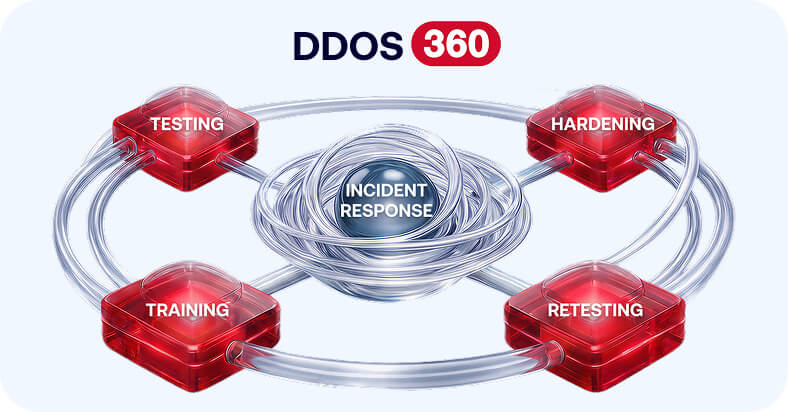
A point-in-time test suits a specific change or incident, but its value ages as APIs, routing, and WAF rules drift. That is the case for annual versus continuous simulation. Where infrastructure changes constantly, a managed program such as DDoS 360 combines testing, hardening, retesting, and training while keeping the load on the internal team low.
The Best DDoS Testing Tool Is the One That Reduces Uncertainty
The purpose of a DDoS test is not to generate the largest possible attack, and it is not to produce a clean report. It is to reduce uncertainty about how your defenses, your providers, and your people will behave when availability is under pressure.
See what a real test report contains: the findings, the resilience score and the remediation roadmap. Judge for yourself whether your current tools produce evidence of that standard. If you would rather start with a conversation, talk to a Red Button DDoS expert about your architecture, protection stack, and testing goals.
Frequently Asked Questions
Are free DDoS test websites safe to use against my own domain?
Two things are worth knowing. You do not own the path: traffic crosses your ISP, CDN, cloud provider, and scrubbing vendor, and their acceptable-use policies bind you regardless of who owns the target. And these services are active law-enforcement targets. In Operation PowerOFF in April 2026, authorities across twenty-one countries seized fifty-three domains, executed twenty-five search warrants, and contacted more than 75,000 identified users. Using one may expose payment, identity, and infrastructure data to an untrusted operator, and potentially to law enforcement if that infrastructure is seized.
Do we need to notify our cloud, ISP, CDN, or scrubbing providers before a test?
These are two separate questions. AWS and Azure both allow an approved partner to conduct simulation testing without a separate customer notification to the provider, because the partner authorization already covers it. That does not extend to anyone else in the traffic path: your ISP, CDN, and scrubbing provider should still be coordinated with during planning, or they may treat the simulation as a genuine attack and begin mitigating, which both invalidates the test and can cause a real outage.
How much of our team’s time does a managed DDoS test require?
Less than most teams expect. Red Button’s engagements require roughly five hours of client time in total: one hour for a pre-test interview to align on the plan, three hours for the live test session, and one hour for the results readout. Planning and scoping run in parallel and typically take about two weeks from kickoff to execution.
What is the difference between a tabletop DDoS exercise and a live simulation?
A tabletop exercise is discussion-based. No traffic is generated, and no infrastructure is touched, so it tests decisions, roles, escalation paths, and communication. A live simulation puts real traffic against real infrastructure and tests the technical stack and the operational response together. Run the tabletop first: it is the inexpensive way to discover that nobody knows who is authorized to call the scrubbing provider at 03:00, before you spend on a live test that stalls on the same question.
About the author