


How to Justify Paid DDoS Testing When You Have Never Been Attacked


To justify paid DDoS testing without a past outage, frame it as quality assurance on protection you have already bought – not as a second protection purchase. The business case rests on what a contract, a configuration, and a provider dashboard cannot show: whether every asset is routed through the mitigation path, and whether real customers could still complete transactions while traffic was being “mitigated.”
Key Takeaways
- Protection and testing are separate budget lines with separate jobs. A contract buys mitigation capacity; only a test shows how the complete service behaved under attack.
- “Mitigated” is a provider metric. “Available” is a business one. A control can block the attack and block your customers at the same time.
- The business case does not need a past outage. It compares the test fee against continuing to pay for an unverified control.
- A paid test earns its budget only when the result can change something – a configuration, an architecture, a runbook, or a risk decision.
Why Should DDoS Testing Be a Separate Budget Line?
“We already pay for Cloudflare, AWS Shield, a WAF, and a scrubbing provider. Why should we pay for another DDoS line item?”
Because protection and testing perform different jobs. Your provider supplies the capacity and controls intended to detect and mitigate an attack. Its contract defines the service, coverage, and SLA, while its dashboard reports what the provider observed within its own platform. An independent test examines the outcome across the complete service path.
|
Budget line |
What it buys |
What it does not buy |
|---|---|---|
|
Scrubbing or CDN contract |
Capacity to absorb and filter hostile traffic |
Confirmation that every critical asset is routed through it |
|
WAF licence |
Application-layer rules and challenges |
Proof that the rules activate without blocking real customers |
|
Monitoring and SIEM |
Visibility into observed events |
Proof that the right person responds within the required window |
|
Independent test |
Evidence of how the complete path behaves |
Continued assurance, unless findings are fixed and retested |
In Red Button’s own simulation data, 68% of the protection faults identified were rated severe or critical- in organisations that had already deployed DDoS protection. Those are Red Button’s findings rather than an industry benchmark, and they describe environments whose procurement records were entirely in order.
Those faults are not evenly spread. Across recent engagements, the most frequently identified were rate-limit or WAF misconfiguration, direct-to-origin exposure, an asset sitting outside the mitigation path, and legitimate users blocked by the mitigation itself. Almost none of these are absences of product. They are configuration and coverage failures inside protection that was already paid for.
Protection is the capability. Testing is the feedback loop that shows whether that capability works in your environment. That is the practical difference between DDoS testing vs. DDoS protection.
Can a Simulation Uncover What Our Monitoring and Mitigation Have Not Caught?
Yes, and the most valuable finding is rarely an attack that got through. It is a defence that behaved exactly as configured while the service it protects stopped working. Monitoring reports on the attack traffic. It rarely reports on whether customers could still transact.
“Mitigated” Is Not the Same as “Available”
Mitigation is an action taken against attack traffic. Availability is what a legitimate customer can still do after that action. Confusing the two creates a dangerous false pass: the provider reports that the attack was blocked, while customers experience failed logins, rejected API calls, or transactions that never complete.
|
Provider scorecard |
Business scorecard |
|---|---|
|
Was attack traffic detected? |
Could customers still log in? |
|
Did mitigation activate? |
Did transactions complete? |
|
How many requests or packets were blocked? |
Did latency remain within tolerance? |
|
Was the contractual SLA met? |
Were legitimate users blocked or challenged? |
|
Did traffic reach the scrubbing layer? |
Did the application and its dependencies remain healthy? |
A credible test therefore runs attack traffic alongside legitimate synthetic transactions, external availability monitoring, application and infrastructure telemetry, and the organisation’s real alert and escalation process.
In one Red Button test of a mobile operator’s API, the WAF responded to rising traffic by activating a JavaScript challenge. From the protection platform’s perspective, the attack had been mitigated. The legitimate mobile application, however, used an API client that could not execute JavaScript, so genuine customers were blocked alongside the attack traffic. The failure surfaced only because a human-led test was watching the customer outcome and could adapt the exercise in real time.
According to Ziv Gadot, Founder and CEO of Red Button, an automated system may record an outcome like this as successful mitigation even though the customer-facing service has effectively failed. The control worked technically and failed operationally – precisely the kind of gap that existing protection and monitoring will not surface until a real attack does it for you.
How Do We Confirm the Protection Works Before an Attack Rather Than During One?
A DDoS test should not begin with a traffic number. It should begin with a measurable business outcome. Without agreed success criteria, a supplier can demonstrate an impressive volume of traffic while the organisation still cannot say whether the money proved anything – which is why the largest available test is rarely the most useful one.
Before approving the test, define:
- Which services and user journeys must remain available.
- The acceptable latency and error-rate thresholds.
- The expected detection and mitigation times.
- Which alerts should fire, and who should receive them.
- Who has the authority to stop the test.
- Which assets and shared dependencies are outside scope.
These criteria turn “our protection worked” into a result that security, operations and finance can each evaluate.
The execution should then follow a controlled sequence:
- Verify ownership and obtain written authorisation.
- Notify the relevant cloud, hosting and mitigation providers.
- Capture a normal-traffic baseline.
- Confirm monitoring and the emergency stop path.
- Begin with controlled traffic, escalating according to the scenario and observed behaviour.
- Monitor attack traffic and legitimate users simultaneously.
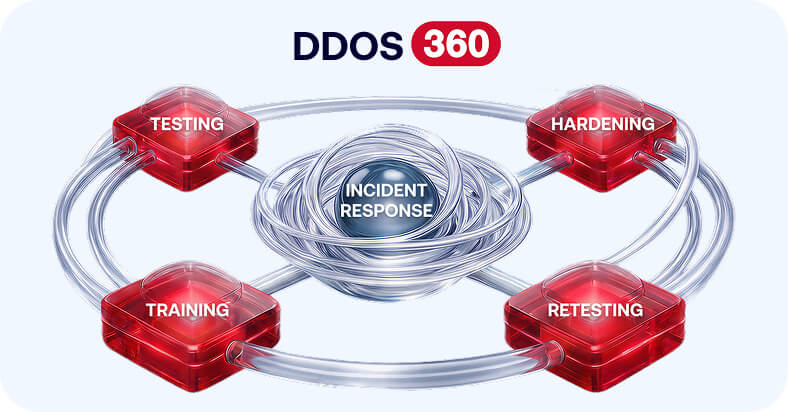
- Document findings, remediate and retest.
Production testing is not risk-free. Its risk is bounded through written scope, controlled execution, active monitoring, agreed stop conditions, and an immediate customer-controlled stop instruction – the controls set out in our DDoS testing checklist and in our guide to whether DDoS testing is safe in production.
Does Our Annual Penetration Test Already Cover This?
A penetration test and a DDoS resilience test examine different security outcomes. One asks whether an attacker can gain access or control. The other asks whether customers can continue using a service while hostile traffic is deliberately trying to make it unavailable.
|
Standard penetration test |
DDoS resilience test |
|
|---|---|---|
|
Security objective |
Access, compromise and data exposure |
Availability under hostile traffic |
|
Typical target |
Vulnerabilities and trust boundaries |
Mitigation, routing, capacity and continuity |
|
Traffic |
Usually limited |
Controlled distributed attack traffic |
|
DoS activity |
Only when explicitly scoped |
Central to the engagement |
|
Main output |
Exploitable security findings |
Service-impact findings and remediation |
|
Success measure |
Could access or control be gained? |
Did the service remain usable? |
Does a Standard Pen Test Include Denial-of-Service Testing?
Not by default. Denial-of-service techniques may be included when explicitly authorised and scoped, but a standard penetration test does not normally validate distributed traffic generation, mitigation-provider response, legitimate-user availability, or the complete DDoS defence path.
The term DDoS penetration testing has no single, universally accepted definition. Some providers use it for attempts to bypass mitigation controls; others use it as a general label for a DDoS simulation. When comparing DDoS testing vs penetration testing, evaluate the objectives, scope, traffic, measurements, and expertise rather than the service name.
DDoS testing therefore belongs in the security-testing calendar alongside penetration testing, not inside it. For regulated entities, the distinction has a regulatory edge: DORA Article 24(6) requires financial entities, other than microenterprises, to ensure “at least yearly, that appropriate tests are conducted on all ICT systems and applications supporting critical or important functions”. Completing the annual pen test does not discharge that obligation for availability unless DDoS resilience was separately and explicitly scoped and tested.
How Do We Justify the Budget When We Have Never Been Hit?
How do you justify paid DDoS testing when the organisation has never experienced a DDoS outage?
Do not build the case around generic downtime estimates or an attack probability nobody can defend. Build it around the organisation’s existing protection investment, the services that depend on it, and the operational assumptions that remain untested.
|
Business-case input |
Question to answer |
|---|---|
|
Existing investment |
What do we already spend on WAF, CDN, cloud protection, and scrubbing? |
|
Critical service |
Which customer, revenue, or regulated service depends on those controls? |
|
Unvalidated assumption |
What do we believe the protection will do but have never observed? |
|
Decision enabled |
What configuration, architecture, runbook, or risk decision could the test change? |
|
Deliverable |
Will the engagement provide findings, remediation guidance, and a retest? |
|
Cost driver |
Which assets, environments, and scenarios determine the price? |
The comparison is not the testing fee versus the cost of a hypothetical catastrophe. It is the testing fee versus continuing to pay for an unverified control whose limitations may become visible only during a real incident.
Independent, expert-led testing is a paid engagement purchased separately from the protection service. There is no universal price before scoping: cost depends on the number of assets, protection layers, cloud environments, attack scenarios, test duration, and whether validation retesting is included.
A test may not yet justify its budget when there is no defined objective, the organisation cannot measure the result, the environment is changing continuously, required authorisations are missing, or nobody owns the remediation work.
A paid test is worthwhile only when its result can change a configuration, architecture, runbook, or risk decision. A scoped DDoS testing service should make those expected decisions and deliverables clear before the engagement is approved.
Why Not Just Run the Test With Our Existing Pen-Testing Supplier?
Your existing penetration-testing supplier may understand your environment, but familiarity alone does not qualify a team to run a controlled DDoS simulation. Evaluate any provider – including Red Button – against the capabilities the engagement actually requires.
Ask:
- Can it generate authorised, distributed attack traffic?
- Is it approved under the relevant AWS or Azure testing policy?
- Can it test volumetric, protocol, and application-layer scenarios?
- Does it measure legitimate-user activity during the simulation?
- Is a human expert controlling and adapting the test?
- Can the customer stop the test immediately?
- Does the report explain business impact and remediation?
- Is validation retesting available?
- Does the team actively research emerging DDoS techniques?
If your current pen-testing provider can demonstrate those capabilities, it may be suitable. If it cannot, placing DDoS activity inside the annual pen-test contract does not create meaningful availability assurance.
Question two is the one most often assumed rather than checked. Cloud providers restrict who may generate simulated attack traffic on their platforms: Red Button is named in Microsoft’s approved Azure simulation partners and operates under the AWS DDoS Simulation Testing policy. The company has focused exclusively on DDoS since 2014, across more than 2,000 controlled simulations, and its engagements are run by human specialists rather than left to a self-service platform – so scenarios can be adjusted as the protection, the application, and legitimate traffic respond. Its DDoS Research Team also investigates emerging techniques, including the HTTP/2 Bomb.
The engagement produces detailed findings, remediation guidance, and optional validation retesting – not a traffic log or a pass/fail result. Compare managed, self-service and automated DDoS testing before choosing the model that fits your risk.
See what a real DDoS test report contains
Frequently Asked Questions
Do we need independent testing if our DDoS provider offers its own test?
A provider-run test can supply useful evidence about the protection layer it operates. Independent testing examines the complete service path, including routing, the origin, APIs, application dependencies, and legitimate-user journeys, and compares the provider’s mitigation data with what customers actually experienced. For regulated entities, DORA Article 24(4) requires tests to be undertaken by independent parties, internal or external, with conflicts of interest avoided.
What determines the price of a DDoS test?
Scope, primarily: the number of assets and domains, the protection layers involved, the cloud or on-premises environments, the attack scenarios required, and the duration of the testing window. Cost also varies with the level of preparation, reporting, and remediation support needed, and with whether a validation retest is included once identified weaknesses have been addressed.
Is independent DDoS testing a paid service?
Yes. Independent, expert-led DDoS testing is a paid engagement purchased separately from your CDN, WAF, cloud protection or scrubbing service. You are paying for authorised attack generation, specialist oversight, measurement, analysis and actionable findings – not for traffic volume. Its value should be assessed by the weaknesses it identifies, the decisions it supports and whether remediation can be verified through a controlled retest.
Where does DDoS testing sit alongside our annual penetration test?
Alongside it, not inside it. The two exercises can share an annual planning and budget cycle, but they assess different outcomes and require different permissions, expertise and success criteria. Cadence should also be risk-based rather than purely annual: material changes to architecture, applications or mitigation providers are a stronger trigger for retesting than the calendar date. A recurring DDoS testing programme aligns that cadence with the wider security calendar.
About the author