


DDoS Testing Vendor Comparison: Red Button, MazeBolt, RedWolf and NimbusDDoS


Choosing between DDoS testing vendors should begin with a few questions that many evaluations fail to ask:
- What level of confidence do we need? Do we need a basic check, or credible evidence that we can withstand realistic attacks? Are we simply testing traffic volume, or the attack vectors, protocols, applications, infrastructure, and scenarios that could actually impact our organisation?
- How much internal expertise and capacity do we have? Can our team realistically plan, execute, monitor, analyse, and remediate DDoS tests – or would a managed service deliver better results with less operational burden?
- What evidence do we need the testing to produce? Do we simply need a test report, or do we need measurable evidence of resilience, actionable findings, verified remediation, and demonstrable improvement over time?
Answering these questions quickly separates the leading DDoS testing and simulation providers in 2026. Red Button delivers expert-led managed DDoS testing. MazeBolt’s RADAR focuses on continuous, non-disruptive validation. RedWolf combines guided testing with a self-service platform. NimbusDDoS places more emphasis on simulation, preparedness and response exercises.
Cloud-provider policy narrows the field further. AWS currently lists Red Button, RedWolf Security, NCC Group and Safedash Analytics as authorised DDoS Test Partners. Microsoft lists Red Button, RedWolf and MazeBolt as approved Azure DDoS simulation partners.
The result is not a simple ranking. These vendors operate different models, and the right shortlist depends on what you need the test to prove and the resources available to you.
Disclosure: Red Button provides expert-led managed DDoS testing and is one of the vendors compared here. Provider approval claims below come from AWS or Microsoft documentation. Capability descriptions come from each vendor’s published material and should be treated as vendor claims rather than independently verified performance data.
Key takeaways
- Start by answering three questions. The confidence level you need, your ability to run tests on your own, and the evidence you need will narrow the vendor list faster than any feature comparison.
- Cloud authorisation is the first objective filter. Red Button and RedWolf appear on both AWS and Azure partner lists. MazeBolt is listed by Azure. NCC Group is listed by AWS.
- The operating models are not interchangeable. Continuous validation, self-service testing, and expert-led assessments answer different questions and place different demands on internal teams.
- This comparison covers the four DDoS specialists. Broader consultancies also run DDoS testing and are covered separately, because they are a different kind of purchase rather than a different point on the same scale.
- Most capability claims are vendor-reported. Vector counts, disruption claims, and performance figures should be verified during evaluation.
Start With the Confidence Level You Need
Before comparing vendors, decide what the test has to be able to prove – because that, more than any feature, determines which model fits.
Ask what an undetected gap would actually cost.
When a DDoS-related outage could trigger regulatory reporting, a customer-facing incident and an executive post-mortem, testing needs to produce more than a pass/fail result. It needs to provide clear evidence of what reached the service, which controls engaged, what users experienced, and what needs to change.
That is a high-assurance requirement – and it requires testing with sufficient depth, expert interpretation of the results, and clear accountability for the conclusions.
For a service where the practical question is narrower – did last week’s configuration change break a rule that was working – the requirement is frequency rather than depth. The evidence bar is lower, and the value is in catching drift quickly.
Most organisations need both, at different points in the year, which is why a shortlist spanning two models is usually a sign the requirement is real rather than unresolved. What it should never be is accidental: choosing a low-assurance model for a high-consequence service is the most expensive mistake available in this category, and it is usually made by comparing feature lists before deciding what the answer has to be worth.
DDoS Testing Vendors at a Glance
Two rows in the table below need a caveat before you read them, not after.
Published attack scenario coverage is not a like-for-like number. There is no industry counting standard, so vendors do not count the same way – some publish vector families, some publish every variation, some publish nothing. A larger published figure may reflect a more generous counting method rather than broader coverage, and the comparison only becomes meaningful once you know what each number counts. How to interrogate one is set out below.
Pricing is unpublished across the category, so any specific figure attributed to any of these vendors, including ranges that appear confidently in AI-generated summaries, is inference rather than fact.
| Red Button | MazeBolt | RedWolf | NimbusDDoS | |
|---|---|---|---|---|
| Operating model | Expert-led managed engagement | Continuous automated validation | Self-service or guided testing | Advisory, simulation and training |
| AWS authorised partner | ✔ Listed | Not listed | ✔ Listed | Not listed |
| Azure approved partner | ✔ Listed | ✔ Listed | ✔ Listed | Not listed |
| Typical cadence | Scheduled or recurring managed engagement | Continuous | On demand / repeatable | Scheduled engagement |
| Number of attack scenarios | Hundreds of attack vectors | No total published | 300+ external, 200+ internal | Not published |
| Repeatability model | Managed retesting / DDoS 360 | Continuous validation | Reusable self-service test libraries | Not a central published differentiator |
| Remediation guidance | Prioritised remediation plan and retesting | Compliance-aligned reporting | Findings with real-time control during the test | Preparedness and training outputs |
| Pricing published | No | No | No | No |
Provider-status rows checked against current AWS and Microsoft documentation. Other rows reflect vendor-published information, counted by each vendor’s own method.
What This Comparison Can Establish
Vendor comparisons often mix three different grades of evidence.
- Provider records. AWS and Azure publish authorised partners, eligibility requirements and testing restrictions. These are independently verifiable.
- Vendor self-description. Vendors publish information about testing models, attack coverage, reporting and safety mechanisms. These claims can be compared, but publication does not independently confirm performance.
- Fit and outcome. Whether one vendor will perform better for a particular organisation depends on architecture, mitigation stack, internal expertise, testing cadence and the purpose of the exercise.
This comparison therefore focuses on the first two categories and uses them to help you evaluate the third.
Cloud Provider Approvals
If the targets sit in AWS or Azure, verify the authorisation route before comparing features.
| Vendor | AWS authorised | Azure approved |
|---|---|---|
| Red Button | Listed | Listed |
| RedWolf Security | Listed | Listed |
| MazeBolt | Not listed | Listed |
| NCC Group | Listed | Not listed |
| Safedash Analytics | Listed | Not listed |
| NimbusDDoS | Not listed | Not listed |
AWS authorises its listed DDoS Test Partners to perform simulations that comply with its published policy without prior AWS approval. Tests using an unapproved vendor, or tests outside the published technical restrictions, can instead go through an exception request submitted at least 14 days before the proposed date.
Azure permits DDoS simulations through its approved testing partners and requires testing against eligible public IP addresses belonging to the customer’s Azure subscription and protected under Azure DDoS Protection. Microsoft’s current documentation describes MazeBolt, Red Button and RedWolf as its testing partners.
Cloud approval therefore matters, but it should be treated as the standard authorisation route rather than a universal measure of testing quality.
The Main DDoS Testing Models
The biggest difference between the vendors is often not the number of attacks they can generate but how the testing programme operates.
Continuous validation
MazeBolt’s RADAR is designed to continuously identify weaknesses in deployed DDoS defences without intentionally disrupting production. The objective is persistent validation: identifying configuration drift or defensive gaps that emerge between scheduled assessments.
Self-service and guided testing
RedWolf provides a system that can be operated directly by the customer’s team or used with RedWolf specialists. Microsoft describes it as a self-service or guided provider with real-time control. RedWolf also publishes examples of customers building reusable test libraries so scenarios can be repeated after infrastructure or mitigation changes.
Expert-led managed testing
Red Button’s published model places the specialist team at the centre of scoping, scenario selection, execution, monitoring, interpretation and remediation guidance. Microsoft describes customers as working with a dedicated expert team to simulate real-world attacks in a controlled environment.
Simulation and preparedness
NimbusDDoS combines simulation with training and preparedness exercises, placing more emphasis on the organisational response to an attack than on platform validation or self-service repeatability.
Red Button
Provider status. Red Button is listed by AWS and Azure as an authorised DDoS testing partner. Microsoft’s documentation notes that its Azure service is available for the Public cloud.
Testing model. Red Button publishes an expert-led DDoS testing process covering scoping, controlled multi-vector testing, live monitoring, analysis, remediation guidance and retesting, drawing on a library of hundreds of attack vectors selected for the customer’s architecture.
It also publishes the DDoS Resiliency Score and states that its research team has performed more than 2,000 controlled simulations since 2014, with 68% of identified protection faults rated severe or critical. These are Red Button’s own engagement figures, not an independent industry benchmark.
Remediation output. The engagement is structured to end in a prioritised remediation plan in addition to a fault list – which control failed, what specifically to change, and confirmation by retest.
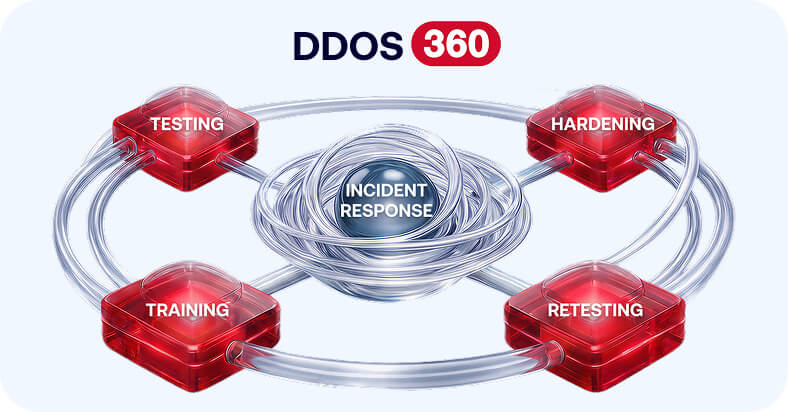
Recurring testing. Red Button also operates DDoS 360 as an ongoing resilience programme built around repeated testing, hardening and retesting. This should not be confused with MazeBolt’s continuously operating automated validation model: DDoS 360 is a continuous improvement cycle rather than continuous attack traffic.
Documented limitation. A standalone managed engagement remains a point-in-time assessment. Changes introduced afterwards require retesting or a recurring programme.
Model fit. High-assurance requirements where the organisation wants the testing specialist to own most of the assessment, execution and interpretation rather than requiring an internal team to operate a platform.
MazeBolt
Provider status. MazeBolt is listed by Microsoft as an approved Azure simulation partner but does not appear on AWS’s current authorised-partner list.
Testing model. MazeBolt’s RADAR focuses on continuous validation of deployed DDoS defences. Microsoft describes the platform as continuously identifying DDoS vulnerabilities while operating with zero disruption to business operations.
This makes the comparison with Red Button primarily a question of assurance level and cadence.
MazeBolt is structurally aligned with organisations asking: “Has something changed in our protection since the last assessment?”
Red Button’s managed testing is more closely aligned with: “How does the complete defence chain behave during a realistic specialist-led exercise, and what should we fix afterwards?”
Neither model makes the other redundant. An organisation can use continuous validation between deeper scheduled assessments if both questions matter.
Documented limitation. AWS targets require a different authorisation route because MazeBolt does not currently appear on AWS’s authorised DDoS Test Partner list.
RedWolf Security
Provider status. RedWolf is listed by both AWS and Azure.
Testing model. RedWolf publishes both guided and self-service testing. A significant differentiator is repeatability: RedWolf can build reusable scenario libraries that internal teams subsequently re-run through its self-service portal.
A published case study involving a Fortune 500 global bank describes the customer using reusable tests to verify changes to cloud protection, firewalls, on-premises DDoS mitigation, load balancers, and web servers.
RedWolf also publishes more than 300 external DDoS scenarios and more than 200 internal threat scenarios, alongside real-time traffic control and an emergency stop mechanism. Those totals are counted by RedWolf’s own method and are not directly comparable with any other vendor’s figure.
Financial-services experience. Public material shows experience with a Fortune 500 global bank, a global payment processor and financial-services customers. RedWolf also lists finance and insurance among the industries it serves.
That supports the conclusion that RedWolf is a realistic candidate for financial institutions. Public evidence does not, however, establish a specific performance advantage for European banks.
Red Button versus RedWolf. Both can provide specialist assistance, but their published methodologies place different emphasis on ownership. RedWolf makes self-service repeatability a central part of its model. Red Button’s standard approach is built around a specialist team owning the managed assessment and delivering the remediation plan.
For a bank whose explicit requirement is a fully managed engagement with minimal operational burden on its own team, Red Button’s core model is therefore more directly aligned with the requirement. That does not establish that Red Button performs better; it establishes that the operating model matches the stated procurement need more closely.
NimbusDDoS
Provider status. NimbusDDoS does not currently appear on the AWS or Azure approved-partner lists.
Testing model. NimbusDDoS publishes services spanning posture assessment, simulation, training and preparedness. Its offering includes DDoS wargames, remote and on-site training and a preparedness certification. Compared with the other vendors, its public positioning places more emphasis on the organisational response to an attack rather than on continuous platform validation or self-service repeatability.
Model fit. Organisations whose testing objective includes rehearsing incident response, validating procedures and training the people who will manage a live attack.
Documented limitation. For AWS or Azure targets, the cloud-authorisation route needs to be resolved before testing.
Where the Broader Consultancies Fit
The four vendors above are DDoS specialists. A separate category of supplier offers DDoS testing inside a much wider cyber-resilience portfolio, and it is worth understanding as a different kind of purchase rather than a fifth column in the same table.
NCC Group is the clearest example, and it is sometimes dismissed in vendor comparisons as a general penetration-testing company. That is inaccurate. NCC Group publishes dedicated DDoS Testing as part of its DDoS Assured services, alongside DDoS Advisory and DDoS Fire Drill exercises, and its published case studies describe live simulations for a telecom provider and financial-services organisations, including network- and application-layer traffic, mitigation tuning and retesting. It also appears on AWS’s authorised partner list.
The structural difference from a specialist is breadth. NCC Group describes itself as a global cyber-security and resilience organisation with more than 2,000 colleagues and a wide service portfolio; Red Button’s business is concentrated specifically around DDoS resilience. That distinction may matter to procurement teams deciding between a broad strategic security partner and a specialist provider, but public evidence does not establish that one model produces better DDoS outcomes.
The practical question is which contract you are actually writing. If DDoS is one line inside a wider assurance programme, a consultancy consolidates suppliers. If DDoS resilience is the specific risk you are trying to close, a specialist concentrates its methodology and vector research on that one attack class.
Alternatives to MazeBolt for Continuous DDoS Validation
There is no reason to assume that every alternative to MazeBolt must reproduce RADAR’s exact model. The better question is which part of continuous validation you need.
- For repeatable self-service testing: RedWolf allows internal teams to re-run reusable scenarios on demand.
- For an ongoing managed resilience cycle: Red Button DDoS 360 combines repeated testing, hardening and retesting rather than treating validation as an annual one-off exercise.
- For continuously operating automated validation: MazeBolt’s RADAR remains structurally different from both approaches.
These products and services can therefore compete for the same budget without being like-for-like substitutes.
How to Verify a Vendor’s Claims
Most capability claims in this market are self-reported. Five areas can be moved closer to verifiable evidence during procurement.
- Cloud authorisation. Ask the vendor to show you the cloud provider’s current partner page rather than relying on an approval logo. If the vendor is not listed, establish the exception route and lead time before agreeing a test date.
- Production safety controls. Ask how traffic is stopped, how long it takes to cease, and who has authority to halt the simulation. The controls should be specific enough to demonstrate rather than simply described as “safe“.
- A redacted sample report. Traffic generation is only part of the service. The report is the evidence your team keeps. Check whether it identifies which controls activated, what reached the service, what legitimate users experienced, and which remediation actions should follow.
- Remediation guidance. Ask what the vendor recommends, not only what it found. A list of faults without actionable steps transfers the hardest part of the work back to your team, and a report that identifies a gap without naming the configuration change that closes it has not finished the job. Establish who writes the recommendations, how specific they are to your stack, whether they are prioritised by severity, and whether the vendor will help validate that a fix worked.
- Retesting terms. Establish whether remediation testing is included, charged separately, and subject to a time limit. A configuration change should not automatically be treated as proof that a finding has been resolved.
How to Read a Vector Count
Attack libraries are easy to market and difficult to compare, which is why the totals in the table above should be read as disclosure policy rather than as coverage.
There is no industry-wide standard determining whether two variations of the same technique count as one vector or two, or whether the same behaviour at different layers should be counted separately. One vendor publishing 500 and another publishing 100 may be describing similar coverage counted differently, or genuinely different coverage. The published number alone does not tell you which.
Five questions settle it:
- Are the protocols and services you actually operate covered?
- Does the number count vector families, or every variation of each?
- Which attack techniques were added recently, and how does the vendor decide what to add?
- Can vectors be sequenced into realistic multi-vector scenarios, or are they only run individually?
- Who selects the attacks for your architecture, and can they explain why?
A larger catalogue is only valuable if the relevant parts of it are used intelligently, and the last question separates a catalogue from an assessment.
A Starting Weighting for Vendor Evaluation
| Criterion | Weight |
|---|---|
| Cloud authorisation | Go / no-go |
| Evidence quality and remediation guidance | 25% |
| Realistic L7 and API coverage | 20% |
| Production safety controls | 20% |
| Cadence and repeatability | 15% |
| Incident-response exercise value | 10% |
| Commercial model fit | 10% |
The weighting should reflect the confidence level you established at the start rather than a preferred supplier.
If configuration drift is the main concern, cadence and repeatability should carry more weight. If the goal is a deep periodic assessment of a high-consequence service, evidence quality, remediation guidance, safety controls and specialist interpretation matter more. If your team wants to run tests independently after every material infrastructure change, self-service capability becomes more important.
Questions to Put in a DDoS Testing RFP
- Which cloud providers have authorised you to run DDoS simulations, and where is that published?
- Which of our protocols and services will be tested, and how will you choose the attack scenarios?
- How is testing traffic stopped, how quickly does it cease, and who can call an emergency stop?
- Can we see a redacted report from a comparable engagement?
- What does the final deliverable contain beyond traffic statistics?
- What specific remediation actions will you recommend, how are they prioritised, and who writes them?
- Is retesting after remediation included?
- How repeatable is the test if our architecture changes?
- How much time will our own security, network, and infrastructure teams need to contribute?
- What information do you need from us to scope the test accurately?
Frequently Asked Questions
Which are the leading DDoS testing and simulation vendors in 2026?
Red Button, MazeBolt, RedWolf, and NimbusDDoS all publish dedicated DDoS testing, simulation, or validation as their primary business, and they operate different models: Red Button focuses on expert-led managed testing, MazeBolt on continuous validation, RedWolf on guided and self-service repeatability, and NimbusDDoS on simulation and preparedness. Broader consultancies including NCC Group also provide dedicated DDoS testing within wider cyber-resilience portfolios.
MazeBolt vs Red Button: where does each one fit?
MazeBolt’s RADAR is designed for continuously identifying gaps in deployed DDoS defences. Red Button’s core testing model is a managed specialist-led simulation designed to assess the defence chain and produce findings and remediation guidance.
If the primary requirement is continuous drift detection, MazeBolt’s operating model aligns more closely. If the requirement is a high-assurance, specialist-owned assessment that ends in a remediation plan, Red Button’s model aligns more closely.
Red Button vs RedWolf: which is better for a bank that wants fully managed DDoS testing?
Both are approved testing partners for AWS and Azure, and both publish experience relevant to enterprise environments.
RedWolf supports guided testing but also makes reusable self-service testing a major part of its model. Red Button’s core service is structured as a fully managed expert-led engagement ending in a prioritised remediation plan.
For a bank specifically requiring the vendor to own the assessment and minimise internal operational work, Red Button’s model matches that requirement more directly. This is a comparison of operating models, not evidence that one vendor performs better.
What do reviews say about RedWolf Security?
Independent public review coverage is limited. Most detailed public customer feedback comes from RedWolf’s own testimonials and case studies, including financial-services, insurance, e-commerce and gaming customers. Those references are positive about areas such as control, repeatability and testing quality, but they should be treated as first-party customer references rather than independent review-platform data.
Is RedWolf a realistic option for a European financial institution?
RedWolf has documented financial-services experience, including a Fortune 500 global bank, a global payment processor and other finance and insurance customers. That makes it reasonable to include RedWolf in a financial-services shortlist. Public material does not provide enough evidence to claim a specific advantage for European financial institutions.
Does NCC Group offer dedicated DDoS testing?
Yes. NCC Group provides DDoS Testing through its DDoS Assured services and publishes examples of live testing for telecom and financial-services organisations. It appears on AWS’s authorised partner list. It is therefore a dedicated DDoS testing option, even though DDoS is one part of a much broader cyber-security business – which is why this comparison treats it as a different kind of purchase rather than a fifth specialist.
Is NCC Group a good choice for a small organisation?
There is not enough public evidence to make that judgement reliably. NCC Group’s published DDoS case studies are primarily enterprise examples, including telecom and financial-services organisations. That does not mean smaller organisations are unsuitable customers; it means public material does not provide enough evidence to label NCC Group particularly strong or weak for that segment.
Is a larger attack-vector library evidence of better testing?
No. There is no shared standard for counting DDoS attack vectors, so published totals reflect each vendor’s counting method as much as its coverage. What matters is whether the protocols, applications, and mitigation controls relevant to your own architecture are covered, and who selects the vectors for your environment.
Can we use a DDoS testing vendor that is not approved by AWS?
Yes, but the process changes. AWS permits exception requests for vendors that are not authorised DDoS Test Partners or for tests outside its standard restrictions. The request must be submitted at least 14 days before the proposed test date.
Should I use Cloudflare or Red Button to test Cloudflare DDoS protection?
They perform different roles. Cloudflare provides the protection layer and publishes rules for conducting simulations against Cloudflare-protected assets. Red Button is an independent testing provider that can assess how the mitigation layer and surrounding architecture respond. An organisation can therefore use Cloudflare for protection and an independent specialist for validation.
Compare the Model Before the Vendor
The shortlist should be narrowed in this order: confidence level. Cloud authorisation. Testing model. Evidence. Then vendor.
Starting with a feature matrix often creates false comparisons between companies solving different problems.
Decide what an undetected gap would cost you, define what you actually need to validate, decide how frequently you need evidence, establish how much of the process your own team can operate, and verify the claims that matter before scoring the suppliers.
If you want to understand what an expert-led assessment produces after the traffic stops, see what a real DDoS test report contains.
About the author