


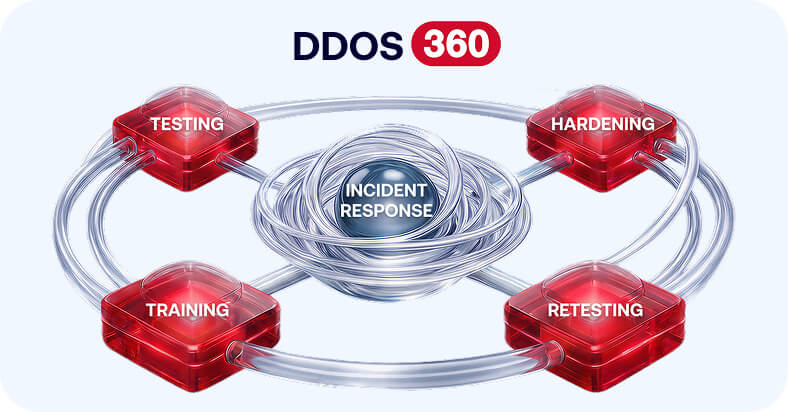
DDoS Resiliency Score (DRS): A Quantitative Approach to Measuring DDoS Readiness

In the complex world of cybersecurity, technical teams often struggle to explain risk to executive leadership, while managers find it difficult to know if their multi-million dollar technology investments are actually working.
The DDoS Resiliency Score (DRS) provides a solution by offering an open, objective standard to measure an organisation’s ability to withstand a Distributed Denial of Service attack.
Key Takeaways
- The DDoS Resiliency Score (DRS) is an open standard for measuring an organization’s ability to withstand DDoS attacks.
- DRS uses a 1.0–7.0 exponential scale to evaluate resilience against increasingly sophisticated attack scenarios.
- The score helps bridge the gap between technical teams and executives by providing a simple, objective measure of risk.
- Organizations can use DRS to benchmark their defenses, validate security investments, and track improvements over time.
What is the DDoS Resiliency Score (DRS)?
The DDoS Resiliency Score (DRS) is an open standard that provides an objective, quantitative yardstick for measuring and assessing an organisation’s ability to withstand DDoS attacks.
Originally developed to fill a “methodological gap” in the industry, it is used to evaluate mitigation strategies, compare different security technologies, and benchmark protection levels against industry peers.
Key characteristics of the DRS include:
- An Exponential Scale: The score ranges from 1.0 to 7.0 and is exponential, similar to the Richter scale for earthquakes. This allows the standard to measure a vast range of threats—from simple, low-volume “poking” attacks to massive, multi-vector 5 Tbps campaigns—on a single, unified scale.
- Seven Ascending Levels: The framework defines seven levels of attack sophistication. Each level introduces higher traffic volumes, more complex attack vectors (such as IP address spoofing or URL randomization), and stricter requirements for the defender’s response time and latency.
- A Common Language: One of the primary benefits of the DRS is bridging the communication gap between technical teams and executive management. While technical teams can analyse the specific attack vectors a score encapsulates, management can use the single number to easily track if the organisation’s risk is increasing or decreasing over time.
- Open and Industry-Adopted: As an open standard available under the GNU Free Documentation License, the DRS is used by various security vendors and consultants worldwide to provide a consistent reference point for DDoS readiness.
Essentially, while individual security findings identify specific vulnerabilities to fix, the DRS tells an enterprise exactly where it stands in terms of overall resiliency against real-world threats.

4 Benefits of Adopting the DDoS Resiliency Score for your Enterprise
An Objective, Quantitative Yardstick
Unlike subjective assessments, the DRS evaluates mitigation strategies in quantitative terms. It uses an exponential scale (similar to the Richter scale for earthquakes) to measure everything from simple, low-volume “poking” attacks to sophisticated, 5 Tbps state-sponsored campaigns. This allows an enterprise to identify exactly which types of attack vectors it can block and which will cause an outage.
Bridging the Management-Technical Gap
One of the greatest benefits of the DRS is providing a common language for communication.
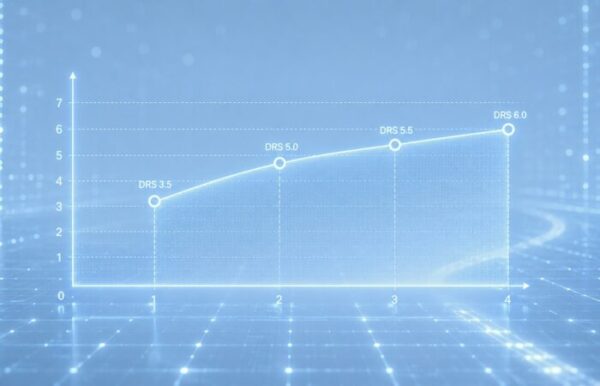
- For Management: A single number (e.g., “We improved from a 3.5 to a 4.7”) clearly demonstrates that risk is decreasing and that remediation efforts are working.
- For Technical Teams: The score encapsulates a specific list of attack vectors, traffic volumes, and mitigation requirements—such as response time and latency—that they can analyse and harden.
Industry Benchmarking and Comparison
Because the DRS is a shared industry yardstick, it allows you to compare your protection levels against your peers. For example, while the average first-test score across industries is 3.0, sectors like finance and gaming often face much higher threat levels (up to 6.0 or 7.0) and must aim for a baseline of 4.5-5.0 to remain resilient. Knowing where you stand relative to your industry helps you accurately focus limited resources on the most critical risks.
Measuring Real Improvement Over Time
A DRS score is not just a one-time snapshot; it allows you to track a trend over time. It ensures that your environment hasn’t “drifted backward” after a major cloud migration or software release. By conducting regular DDoS simulation testing, enterprises receive a detailed report with their current score and specific recommendations for technology hardening.
The Bottom Line: Individual security findings tell you what to fix, but the DRS tells you where you stand. It contextualises technical data into a strategic roadmap, ensuring your DDoS related decisions and technology investments are both cost-efficient and effective
How The DRS Score is Calculated
The DDoS Resiliency Score is calculated using an exponential scale (similar to the Richter scale) ranging from 1.0 to 7.0. It measures an organisation’s ability to withstand increasingly severe DDoS attacks by evaluating them against seven ascending levels of intensity and sophistication.
The calculation process follows these specific steps:
Sequential Testing
Attacks are conducted in a specific sequence, starting from Level 1 (“poking”) and moving upward through levels like Level 4 (“sophisticated”) or Level 7 (“state-sponsored”). An organisation must effectively mitigate the attack vectors within a level to progress to the next one.
Passing Individual Attack Vectors
For every attack vector within a level (such as a SYN Flood or DNS Query Flood), the organisation is graded as “Passed” or “Failed”. To pass, the targeted service must remain functional and meet two critical requirements:
- Mitigation Response Time: The service must be restored within a specific “Maximal Outage” window (e.g., 1 hour for Level 3, but only 20 seconds for Level 7).
- Latency: The service must operate within a “Maximal Latency” threshold, which becomes stricter as the level increases (e.g., 3 seconds for Level 3 down to 0.5 seconds for Level 7).
Calculating the Level Score
The score for a specific level is determined using a standard mathematical formula: Level Score = (Passed Attack Vectors ÷ Total Vectors in that level) + (Level Number – 1).
- Example: If an organisation is tested at Level 3 (which includes multiple vectors) and passes 4 out of 10 vectors, the Level Score would be 2.4 (calculated as 0.4 + ).
Determining the Final Score
The final DRS depends on whether the organisation “Passed,” “Met,” or “Failed” the final level attempted:
- Passing a Level: Requires passing 75% of vectors for Levels 1–3, and 85% for Levels 4–7. If a level is passed, the test continues to the next higher level.
- Meeting a Level: If the score falls between the “Passing” and “Failing” (40%) marks, the level is considered “Met.” In this case, the test stops, and this current Level Score becomes the Final Score. For example: A score of 3.8 indicates the organisation passed Level 3 but “met” the criteria for some of Level 4 without passing the level entirely.
- Failing a Level: If the score is below 40%, the level is “Failed.” The test stops, and the Final Score reverts to the score of the last successfully passed phase.
Key Factors Impacting the Score
The difficulty of each level increases based on four primary factors:
- Traffic Volume: Scaled from 100 Mbps at Level 1 to 5 Tbps at Level 7.
- Attack Sophistication: Each level introduces new techniques, such as IP Address Spoofing (starts at Level 2), URL Randomization (Level 4), or Hiding Tool Fingerprints (Level 6).
- Botnet Size: The number of participating bots increases from 10 at Level 1 to 1 million at Level 7.
- Persistence: The expected duration of the campaign grows from 1 hour at Level 1 to 1 year at Level 7.
Conclusion
DDoS resilience should not be judged by the technologies you own, but by the attacks you can withstand. The DDoS Resiliency Score provides an objective way to measure that capability, benchmark it against industry expectations, and demonstrate progress over time. For organisations serious about validating their defenses, the question is no longer “Do we have DDoS protection?” but “What is our DRS?”
Contact Red Button to assess your DDoS Resiliency Score and understand how well your defenses perform against real-world attacks.
FAQs
What is the DDoS Resiliency Score (DRS)?
The DDoS Resiliency Score (DRS) is an open standard that quantitatively measures an organization’s ability to withstand DDoS attacks. It evaluates defenses against real-world attack scenarios and assigns a score between 1.0 and 7.0.
How is the DRS score calculated?
The DRS is calculated through structured DDoS simulation testing. Organizations are assessed against multiple attack vectors across seven increasing levels of attack volume and sophistication. The final score reflects how effectively services remain available and responsive during testing.
Why is the DRS important for enterprises?
DRS provides an objective way to measure DDoS readiness, benchmark protection levels against industry peers, and demonstrate the effectiveness of security investments to both technical and executive stakeholders.
How often should organizations measure their DRS?
Organizations should assess their DRS regularly, especially after infrastructure changes, cloud migrations, major software releases, or security upgrades. Periodic testing helps ensure defenses remain effective and resilience improves over time.
About the author