


How to Prevent DDoS Attacks: Five Practices That Reduce Risk


DDoS attack prevention requires more than deploying a protection product and assuming it will work. To prevent DDoS attacks from causing disruption, organizations need layered protection, carefully tuned controls, reduced exposure, and regular validation. After conducting 2,000 DDoS tests and simulations for organizations of different sizes and architectures, Red Button has identified five practices that consistently strengthen resilience.
These practices span prevention and mitigation. Some reduce the attack paths and resources available to an attacker, while others absorb or filter malicious traffic before it causes an outage. Together, they form the foundation of an effective DDoS prevention and mitigation strategy.
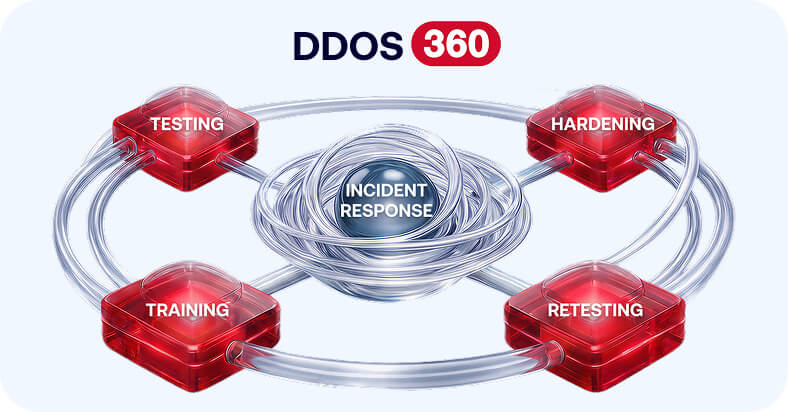
Organizations that need to apply these practices continuously can use Red Button’s DDoS 360 managed resilience program, which combines testing, hardening, retesting, training, and incident-response support.
1. Make Cloud-Based DDoS Protection the Baseline
Regardless of where your data resides, cloud-based DDoS protection is the baseline for DDoS attack prevention at scale. This can include managed protection services offered by your cloud provider, a third-party cloud WAF, a scrubbing center, or a hybrid of these.
On-premises DDoS appliances alone can no longer handle the scale of modern attacks. Their protection capacity is limited by the available internet bandwidth and the appliance’s CPU, whereas cloud-based solutions leverage vast, globally distributed networks (CDNs) capable of absorbing massive traffic surges.
Cloud-based protection works by filtering malicious traffic at the edge—well before it reaches your infrastructure. Automated and customizable defenses at both the network and application layers provide high-capacity mitigation with minimal latency.
For optimal resilience, combine your existing on-premises protection with cloud-based services. In such a multi-layered defense, your local appliance can detect and block early-stage or low-volume attacks, while the cloud-based layer absorbs large-scale assaults. This layered approach forces attackers to bypass multiple defenses, significantly increasing the likelihood of successful mitigation.
2. Implement Custom and Rate-Limiting Rules
Rate limiting is one of the most effective methods for reducing the risk of denial-of-service conditions. It works by defining thresholds for how many requests a client can make within a specific timeframe. For instance, a login API might allow no more than five attempts per second from the same IP address.
Effective rate limiting should be adaptive—based on user type, service function, and behavioral patterns—to maintain both security and usability. For example, in a recent engagement with an online gaming company, we implemented a two-tiered rate-limiting framework to protect against hit-and-run DDoS attacks: one layer applied standard thresholds, while the second triggered managed challenges for suspicious traffic bursts.
However, rate-limiting rules must be carefully calibrated. Overly strict thresholds can block legitimate users or disrupt normal operations. Continuous analysis of traffic baselines helps fine-tune these settings to ensure strong protection without compromising user experience.
Rate limiting is also not prevention on its own – rate limits fail against distributed DDoS attacks when request volume is spread across enough sources to stay under every threshold. For tuning the rules themselves, see our six tips for preventing DDoS attacks using rate limits.
Custom rules further strengthen defenses by addressing specific threats or usage patterns. Examples include blocking access from known malicious IP ranges, enforcing file upload size limits, or restricting HTTP methods and paths to only those required by the application. Tailored rules provide the flexibility needed to counter unique attack vectors.
3. Use Caching to Absorb Attack Traffic
Caching plays a critical role in maintaining service availability during DDoS attacks. By serving cached content, your system reduces load on backend servers and absorbs sudden traffic spikes.
Strategic caching can mitigate large file download attacks: even when an attack reaches the origin, cached resources from the CDN sustain partial service and reduce downtime. Consider a GET flood DDoS attack targeting a site’s homepage. While you cannot cache all elements of the page, you could cache the static elements, thereby increasing the resiliency of the page to withstand a large-scale attack. Static content can be cached for extended periods, while dynamic elements need to be updated more frequently.
A well-optimized caching strategy not only enhances performance under normal conditions but also acts as a frontline buffer during traffic surges.
4. Reduce Your DDoS Attack Surface
Reducing the attack surface is the cheapest form of DDoS attack prevention there is, and a fundamental cybersecurity principle. Every unnecessary port, protocol, or HTTP method represents a potential vulnerability for exploitation.
Audit your infrastructure to ensure that only essential services are exposed. For example, if a web page doesn’t require POST requests, block them. Similarly, if your application doesn’t use UDP, disable it entirely. These simple but often overlooked steps can eliminate many common DDoS entry points before attackers can exploit them.
The gaps are usually not exotic – two misconfigurations account for most of what we find in the field.
5. Validate Your Prevention Controls Periodically
DDoS protection is not a “set-and-forget” deployment. The threat landscape evolves constantly – attack tools, vectors, and tactics are becoming more complex and automated.
Regularly simulate DDoS scenarios on a recurring testing programme to validate your mitigation systems, identify blind spots, and verify that detection and response workflows perform as expected. Continuous testing ensures that your configurations remain effective against both emerging and known attack types.
Periodic validation also provides valuable operational insights – highlighting misconfigurations, underperforming components, and optimization opportunities – before attackers do.
Validation is where prevention stops being an assumption: DDoS mitigation fails in practice most often because no one established how the controls behave under load.
Validate Your DDoS Prevention Strategy Under Real Conditions
Configuring protection controls is only the first step. A controlled DDoS test shows whether your cloud protection, rate limits, caching, routing, and response procedures work together when exposed to realistic attack traffic.
Red Button designs and runs authorized DDoS tests and simulations around your architecture, providing clear evidence of what held, what failed, and what needs to change.
Schedule a DDoS testing engagement to validate your prevention controls before you have to rely on them during a real attack.
Frequently Asked Questions
What Is DDoS Attack Prevention?
DDoS attack prevention is the combination of architectural, technical, and operational measures used to reduce the likelihood that an attack will disrupt a service. These measures include cloud-based protection, tuned rate limits, caching, attack surface reduction, and regular testing.
Can DDoS Attacks Be Completely Prevented?
Organizations cannot stop attackers from generating malicious traffic. They can, however, prevent much of that traffic from reaching critical infrastructure and reduce the likelihood that an attack causes an outage. Effective prevention focuses on maintaining availability, rather than assuming every malicious request can be blocked.
What Are the Most Effective Ways to Prevent DDoS Attacks?
The most effective approach combines several layers of protection. Cloud-based mitigation absorbs large traffic volumes, rate limits and custom rules protect application resources, caching reduces pressure on origin servers, and attack surface reduction removes unnecessary exposure. These controls should then be validated under realistic conditions.
Is Cloud-Based DDoS Protection Enough on Its Own?
No protection service guarantees complete coverage. Unprotected assets, exposed origin servers, routing errors, default WAF settings, and application-layer attack paths can allow traffic to bypass cloud protection. Organizations should verify that every public service is routed through the intended protection layer and that the controls respond as expected.
How Often Should DDoS Prevention Controls Be Tested?
Most organizations should complete a broad DDoS test at least annually and run additional targeted tests after significant architectural changes, new public-facing services, protection-provider changes, or remediation work. High-risk organizations may need a recurring testing program with several planned validation cycles each year.
About the author