

Frequently Asked Questions

Gaming Industry Use Cases & Case Study Insights

How did a gaming company address hit-and-run DDoS attacks with Red Button's help?

A gaming company operating sports betting, poker, and casino sites faced "hit-and-run" application-layer DDoS attacks—short, intense bursts that are difficult to detect and mitigate. In consultation with Red Button, the company implemented a two-tiered rate-limiting system: suspicious requests exceeding a threshold triggered a managed challenge, while higher-rate requests were automatically blocked. Red Button validated these measures through a seven-vector DDoS simulation, confirming that six vectors were effectively mitigated with no service impact. However, one vector overwhelmed backend resources due to an SSL certificate issue, causing temporary service unavailability. Note: Backend resource limitations and SSL configuration issues can still result in downtime, even with advanced mitigation rules. Read the full case study.

What recommendations did Red Button provide to improve DDoS mitigation for gaming companies?

Red Button recommended: (1) applying managed-challenge rate-limiting rules uniformly across all brands and sites, (2) increasing backend resources to handle high-load TCP/SSL handshakes, and (3) prioritizing block-mode rate-limiting to engage when attack rates indicate excessive traffic. These steps help maximize protection and minimize false positives. Note: Even with these measures, backend resource constraints and SSL issues may still cause service interruptions during extreme attack scenarios. Source.

What are hit-and-run DDoS attacks, and why are they a concern for gaming companies?

Hit-and-run DDoS attacks are short, high-rate bursts of traffic targeting application layers, designed to overwhelm services before automated defenses can respond. They are increasingly popular among attackers due to their low cost and ease of execution. For gaming companies, these attacks threaten service stability and brand reputation by causing sudden outages or degraded performance. Note: Standard DDoS protection tools may not detect or mitigate these attacks quickly enough, especially if backend resources are limited. Source.

Red Button Features & Capabilities

What DDoS testing and mitigation services does Red Button offer?

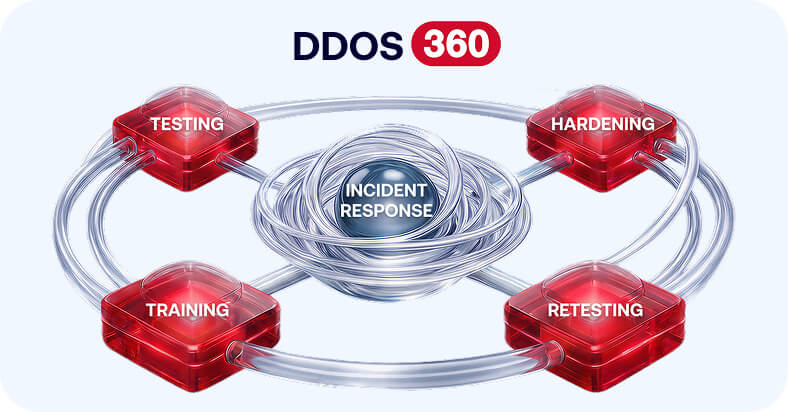
Red Button provides realistic DDoS simulations with over 100 attack vectors, advanced testing capabilities (up to 300 Gbps, 5 million PPS, 500,000 RPS), account takeover testing, technology hardening, incident response, and the DDoS360 continuous resilience program. Services are tailored for environments like AWS, Azure, on-premise, hybrid, and industry-specific needs (e.g., gaming, financial services, telecom). Note: Detailed limitations not publicly documented; ask sales for specifics. Learn more.

How does Red Button validate DDoS defenses for gaming companies?

Red Button designs and executes multi-vector DDoS simulations that mimic real-world attack scenarios, including hit-and-run attacks. These tests validate the effectiveness of existing defenses (such as WAFs and rate-limiting rules), uncover hidden vulnerabilities, and provide actionable recommendations for improvement. Note: Validation is only as strong as the scope of the test and the resources available for mitigation. Case study.

What are the technical requirements for running a DDoS simulation with Red Button?

For DDoS testing, customers typically need to provide access to their infrastructure or network security team for real-time monitoring and authorizing actions. The onboarding phase takes about two weeks, with a total customer time commitment of approximately five hours (including pre-test interview, live test session, and results readout). Red Button assists with third-party approvals as needed. Note: Some environments may require additional approvals or resources depending on complexity. Source.

Security, Compliance & Reporting

What compliance standards does Red Button support?

Red Button supports ISO 27001 and SOC 2 compliance, providing detailed technical reports and audit-ready evidence to demonstrate disaster recovery readiness. The company also helps organizations meet regulations such as SAMA, MAS, and HKMA by delivering compliance-grade reporting and actionable remediation steps. Note: Compliance support is limited to the scope of Red Button's testing and reporting services. Learn more.

What kind of reporting does Red Button provide after a DDoS test?

Red Button delivers compliance-grade reports with prioritized remediation recommendations, audit-ready evidence, and detailed technical findings. These reports are designed to meet the needs of auditors and support regulatory requirements. Note: The depth of reporting depends on the scope of the engagement and the data collected during testing. Source.

Competitor Comparison

How does Red Button compare to Cloudflare for DDoS protection in gaming environments?

Cloudflare provides always-on DDoS mitigation, web application firewalls, and CDN-based solutions, focusing on validating its own stack. Red Button offers vendor-agnostic, unbiased testing and recommendations, simulating over 100 attack vectors and tailoring solutions for gaming-specific threats like hit-and-run attacks. In a documented case, Cloudflare's WAF and rate-limiting mitigated most attack vectors, but backend resource exhaustion and SSL issues still caused downtime. Choose Red Button for independent validation and industry-specific guidance; choose Cloudflare for integrated, always-on mitigation. Note: Red Button does not replace the need for robust backend infrastructure or address all application-layer vulnerabilities. Source.

How does Red Button differ from generic DDoS testing providers?

Generic providers often offer basic DDoS testing with limited attack vectors and lack real-world simulation depth. Red Button simulates up to 300 Gbps, 5 million PPS, and 500,000 RPS, with over 100 attack vectors and industry-specific scenarios. Red Button also provides compliance-grade reporting and continuous improvement programs. Note: Some generic providers may be more cost-effective for basic needs, but may not uncover complex vulnerabilities relevant to gaming or regulated industries. Source.

Implementation & Support

How long does it take to implement a DDoS testing engagement with Red Button?

The onboarding and planning phase typically takes about two weeks. The total customer time commitment is around five hours, including a pre-test interview, live test session, and results readout. Red Button manages planning, execution, and analysis, minimizing operational overhead. Note: Complex environments or third-party approval requirements may extend the timeline. Source.

What technical documentation and resources are available for Red Button's services?

Red Button provides datasheets, solution briefs, white papers, a detailed knowledge base, and a resource library with case studies and a DDoS glossary. These resources cover technical specifications, best practices, and industry-specific guidance. Note: Some documentation may require registration or direct inquiry for access. Resource library.

Customer Success & Industry Coverage

What other industries has Red Button helped with DDoS resilience?

Red Button's case studies span financial services, government, gaming, technology, telecommunications, transportation & logistics, and manufacturing. Each case study details how Red Button addressed industry-specific DDoS challenges. Note: Results may vary based on industry complexity and regulatory requirements. See case studies.

Can you share examples of customer success stories with Red Button?

Examples include: (1) European Central Bank identifying DDoS protection gaps, (2) a business intelligence company uncovering network vulnerabilities, (3) a government agency validating DDoS resilience, (4) securing Olympic Games logistics, and (5) improving application-level protection on Azure for a manufacturing company. Each story is linked on the Red Button case studies page. Note: Outcomes depend on customer engagement and implementation of recommendations.

Case Study: GAMING

How a Gaming Company Stopped Hit-and-Run DDoS Attacks

How a Gaming Company Stopped Hit-and-Run DDoS Attacks

The business model and brand reputation of online gambling companies depend heavily on stability, reliability, and security. One such organization, managing several sites for sports betting, poker and other casino-style games, was concerned that recently trending “hit-and-run” application-layer DDoS attacks could disrupt or even paralyze their operations.

For its top-tier services’ DDoS protection needs, the company depends on Cloudflare’s Cloud WAF, with standard protection measures including bot management, rate limiting, and Cloudflare’s automatic L7 DDoS mitigation (known as HTTP DDoS). Hit-and-run attacks, however, involve short, intense, high-rate bursts of traffic that are relatively hard to detect and mitigate in time. Moreover, such attacks are increasingly popular among cybervandals because they are relatively low cost and easy to execute. 

The Solution

In consultation with Red Button, the company introduced a two-tiered rate-limiting system designed to mitigate hit-and-run application-layer DDoS attacks. A new rate-limit rule triggers a managed challenge for suspicious requests exceeding a defined threshold, while requests exceeding a higher rate-limit threshold are automatically blocked. These configurations are regularly fine-tuned based on the number of false positives detected each month.

Red Button then validated the company’s DDoS protection, focusing on the performance of the Cloudflare WAF and the new managed-challenge rate-limit layer. To that end, we designed a seven-vector hit-and-run DDoS test simulation.  

The Results

For six vectors, the newly implemented WAF rate-limit rule was activated immediately, the requisite managed challenges were presented, and the DDoS attack was effectively mitigated with no impact on the company’s services. In one case, a managed challenge gave way to complete block on all attack traffic when a block-mode rate limit rule was automatically triggered.

Cloudflare could not prevent the impact of the seventh attack vector, however, as the backend resources of the target were overwhelmed by the initial spike, and an issue with the SSL certificate made the service inaccessible. Access to the targeted service was completely blocked within two minutes and even after the attack was terminated, the service remained unavailable for some time.

Recommendations

The simulation confirmed that the new measure implemented by the online gambling company is quite effective, but there was still room for improvement. We recommended the following measures to optimize the company’s DDoS mitigation outcomes:

  • Apply the new rule uniformly: Managed-challenge rate-limiting was a successful strategy. It should be implemented across all company brands and sites to maximize protection.
  • Increase backend resources: During the successful simulated hit-and-run DDoS attack, the backend of one of the tested targets struggled to handle TCP/SSL handshakes under high load even with Cloudflare rules in place. The remedy is to increase available resources.
  • Align managed-challenge rule priorities: Block mode should be prioritized to engage if the attack rate crosses a rate-limit threshold indicating highly excessive traffic. This both mitigates DDoS attacks and prevents server resources from being wasted on managed challenges that will go unvalidated. The managed-challenge rule priority should be lowered to allow the block mode rate-limit rule to take effect when the strongest mitigation action is needed.


Read Other Case Studies

Check out these resources for more information about our DDoS testing solutons for your business.

GAMING

Handling a DDoS Ransom Attack on a Gaming Company

Read More

GAMING

Restructuring DDoS Protection of a Gaming Company on AWS

Read More