


What Breaks in a DDoS Runbook When You Finally Test It


DDoS runbooks fail under test because the procedures that look straightforward on paper depend on people, systems, and decisions nobody has validated. Responders lack access to the tools the document assumes. Escalation stalls on an authorisation no one on call can give. Backup communication channels turn out to run over the infrastructure that is already degraded. Mitigation activates, and the service still does not recover. These gaps stay hidden until a realistic exercise puts the process under load.
A runbook might instruct a team to identify an attack, contact the mitigation provider, and activate the appropriate controls. But what happens when the person authorised to make that decision is unavailable, or the team cannot reach the systems it needs? Those are operational dependencies, and a checklist cannot verify them.
Testing a runbook is therefore not about confirming that the right procedures are documented. It is about discovering whether they can be carried out under realistic conditions. This article is about the runbook itself — if an attack is under way now, start with what to do when you’re under a DDoS attack.
The Dependencies a Runbook Never Declares
Runbooks describe incident response as a sequence of tasks. In practice, those tasks depend on one another: an engineer needs working access before changing a WAF rule, a mitigation provider may require authorisation before rerouting traffic, and the incident commander needs reliable data to confirm whether the action worked.
A document review verifies that the steps exist. Only a test reveals whether their prerequisites, hand-offs, and success criteria hold while the response is running.
This is also where runbook failure differs from protection failure. A control that was never configured correctly is a gap in the mitigation itself. The failures below are different: the protection may be sound, and the response around it still does not execute.
The expectation that you have a plan is not in dispute. The joint CISA, FBI, and MS-ISAC guidance on DDoS attacks tells organisations to develop a comprehensive incident response plan defining roles, communication channels, and predefined mitigation strategies. Most organisations have done exactly that. The question is whether the plan they wrote survives contact with an attack.
Four Runbook Steps That Break Under Test
1. Nobody Agrees Which Alert Starts the Runbook
Runbooks instruct teams to detect and classify an attack without defining which signals warrant action. During an exercise, network monitoring shows abnormal traffic while application dashboards report rising errors – and responders cannot say whether the runbook has been triggered or not.
Testing should establish which alerts start the procedure, who declares the incident, and which metrics give a reliable picture of impact. Record the time between the first relevant alert and the decision to act, together with any missing or conflicting information that delayed it.
2. Responders Cannot Reach Critical Tools
A runbook may instruct engineers to update WAF rules or activate emergency mitigation, assuming they can reach the systems involved. But the corporate VPN, identity provider, or DNS service they depend on may itself be affected during an attack.
Testing exposes expired credentials, missing permissions, and emergency access procedures nobody has ever used. Even where break-glass accounts exist, the on-call team often does not know how to reach them.
A practical exercise should confirm that designated responders can reach critical management tools through approved emergency access, and perform their assigned actions without depending on systems that may be degraded. This is one of the gaps a controlled DDoS testing engagement is designed to surface.
3. Decision Authority and Provider Escalation Stall
The runbook says to activate upstream mitigation. Who has the authority to approve it? Exercises routinely find that the designated decision-maker is unavailable, or that the provider requires account verification nobody on call can complete. A straightforward technical action becomes a prolonged escalation.
Testing should establish who can authorise emergency changes, which backup decision-makers exist, and whether the provider’s escalation procedure works as documented. Measure the time from the decision to request mitigation until the provider confirms the action – not until someone made contact. Knowing in advance what your DDoS incident response arrangement actually commits the provider to is part of the same exercise.
4. Backup Communication Channels Don’t Work
Runbooks assume responders can coordinate through their usual messaging platform, email, or conference bridge. If access to those services depends on affected network infrastructure, VPN connectivity, or identity systems, communication becomes unreliable exactly when it matters.
An exercise also surfaces outdated contact lists, missing external provider contacts, and confusion over who speaks to management and to customer-facing teams.
Testing should include a deliberate loss of the primary channel. Responders have to demonstrate that they can stand up an independent, secure alternative, reach the people who need to know, and hold a shared picture of the incident without the disrupted systems.
Tabletop, Dry Run or Live Simulation: What Each One Proves
A tabletop exercise confirms that responders understand their responsibilities and escalation procedures. Knowing what to do is not the same as proving that the tools, permissions, and mitigation controls will work.
|
Exercise type |
What it can validate |
|---|---|
|
Tabletop exercise |
Decision-making, roles, escalation paths and communication procedures |
|
Technical dry run |
Access permissions, management tools, provider workflows and configuration changes |
|
Controlled DDoS simulation |
Detection, mitigation effectiveness, and operational response under realistic traffic, when responders take part |
These complement one another. A successful tabletop does not establish technical readiness, and a simulation focused only on mitigation misses human coordination failures.
NIST SP 800-61 Rev. 3, which replaced the 2012 incident-handling guide in April 2025, treats this as a continuous-improvement obligation rather than an optional extra: procedures should be tested or exercised periodically to verify their accuracy, and improvements should come from those tests and exercises — including ones run with suppliers and third parties.
On running a live test without causing the outage you are trying to prevent, see our guide to DDoS testing in production.
Turning a Failed Step Into a Verified Fix
A failed runbook step is only useful when it produces a verifiable improvement. For each finding, record what should have happened, what actually happened, the evidence of failure, and its impact on the response. Assign one owner – updating access permissions, clarifying decision authority, correcting a provider escalation path.
Then retest the affected step with the people who would execute it during a real incident. Success has to be observable: a responder reaching an emergency console, a provider completing an escalation, service health returning to the agreed threshold. Updating the document closes a documentation gap. Repeating the failed action successfully closes the operational one.
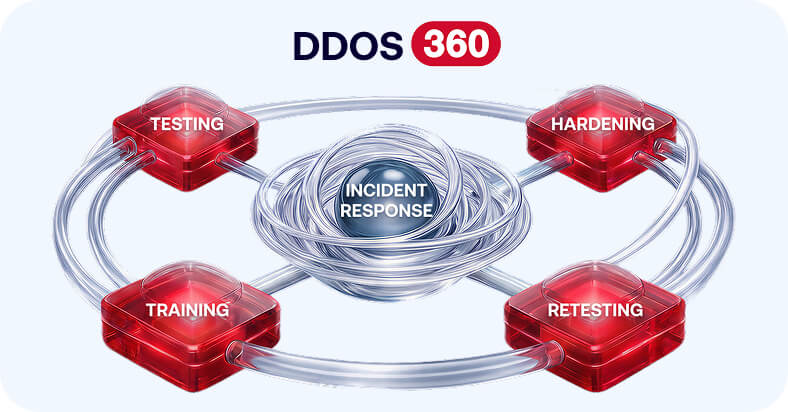
Most of what this produces lives with your team rather than in a report, which is why the cycle works better as a recurring testing programme than as a one-off exercise.
A Runbook Is Only as Reliable as Its Last Test
A reliable DDoS runbook is not one that documents the right procedures. It is one that responders can execute, with the tools and authority actually available to them, in a way that demonstrably restores service.
Testing exposes the assumptions documentation cannot verify. Closing those gaps before a real incident is what turns a written plan into an operational capability.
Find out which steps in your runbook hold up under realistic attack conditions. Talk to Red Button about your testing requirements.
Frequently Asked Questions
Who should take part in a DDoS runbook exercise?
The incident commander, the SOC or security team, network and application owners, and anyone who approves emergency changes. Depending on the scenario, communications teams and the external mitigation provider should take part too. Include backup responders, so the process does not quietly depend on one individual – whether your teams are trained to act is what the exercise is measuring.
How do you know whether a DDoS runbook test has passed?
Define success before the exercise, using measurable criteria: detection and escalation times, successful execution of the required actions, mitigation effectiveness, and service recovery. Completing every checklist item is not a pass if the operational outcome was not achieved.
When should a DDoS runbook be retested?
After changes to infrastructure, mitigation providers, routing, access controls, or response-team responsibilities. Any procedure that failed should be retested once remediated. Beyond those triggers, set a risk-based schedule so the procedures stay aligned with the environment they describe.
About the author