

What Claude Mythos Means for DDoS Resilience


When Anthropic announced the Claude Mythos Preview in April 2026 and restricted its release under Project Glasswing due to its advanced cybersecurity capabilities, the security industry paid immediate attention. The framing that followed was understandable: a model this capable of finding and exploiting vulnerabilities represents a meaningful shift in the threat landscape. For general cybersecurity, that framing has real merit.
For DDoS specifically, the picture is more nuanced-and worth examining carefully.
Mythos matters for DDoS protection, but not primarily because of what it can do today. It matters as a symbol of where AI reasoning is heading, and what that trajectory means for a threat landscape where the barrier to entry is already falling, even without Mythos-class capability in play.
Key Takeaways
- AI is measurably lowering the entry point into the DDoS ecosystem through accessible tooling, AI-assisted scripting, and accelerated reconnaissance.
- As of mid-2026, there is no publicly documented, forensically confirmed DDoS campaign in which AI was used in attack tooling or orchestration.
- DDoS vulnerabilities fall into three distinct categories, each requiring a different discovery method, and only one maps cleanly to where frontier AI models like Mythos appear most capable.
- Mythos is not an immediate DDoS threat, but it is a symbol of the reasoning trajectory that will eventually matter across all three vulnerability categories.
- The right response is not to wait for a confirmed AI-DDoS incident. It is to find your vulnerabilities first, under controlled conditions.
AI Is Lowering the Entry Point-That Much Is Already Happening
Before examining Mythos specifically, the baseline needs to be clear: AI has already changed who can participate in the DDoS ecosystem, even without frontier-model access.
The most concrete evidence is found in tooling. The “malicious LLM” ecosystem-WormGPT, KawaiiGPT, GhostGPT, and others-puts attack-script generation within reach of actors who previously lacked the technical skill to write functional code. These tools demonstrably exist. While their real-world impact is heavily contested and sometimes overstated by the vendors who report on them, the direction of the effect is not in dispute: the entry point into offensive, DDoS-relevant capability is lower than it was two years ago.
The most forensically grounded single example comes from January 2025: a threat actor using the handle “KuroCracks” posted an open-source router-exploit scanner on Cracked Forum. They explicitly stated it was “optimized using ChatGPT” and shared the prompt-engineering techniques they used (later documented by S2W TALON threat intelligence). That is a confirmed instance of commodity AI accelerating the pipeline from vulnerability discovery to botnet recruitment. It didn’t require a Mythos-class model or a sophisticated state actor-just a publicly available tool and a forum post.
This is the part of the AI-DDoS story that is already real. It is not about Mythos; it is about the general improvement in AI reasoning and code-generation capability that is already accessible to anyone motivated enough to look for it.
What Is Not the Story: A Confirmed AI-DDoS Attack
This point deserves to be stated directly, because most commentary in this space avoids saying it clearly: as of mid-2026, there is no publicly documented, forensically confirmed denial-of-service campaign in which a credible independent source verified that AI was actually used in attack tooling or orchestration.
The cases most often cited do not hold up under close inspection. The DeepSeek attack in January 2025-frequently described as an “AI-DDoS” attack-involved a conventional Mirai-variant botnet targeting the DeepSeek infrastructure. The AI was the victim, not the weapon. Similarly, Nullsec Philippines’ promotion of the vire.cc booter platform, which advertises “AI-based methods,” rests entirely on criminal marketing copy with no independent technical validation behind it.
The one genuinely confirmed case of an AI-orchestrated cyberattack-Anthropic’s GTG-1002 disclosure in November 2025, involving Claude Code executing 80–90% of tactical operations autonomously-occurred during an espionage campaign attributed to a Chinese state-sponsored group. It focused entirely on reconnaissance and data exfiltration, not DDoS. While it is the strongest existing proof that agentic AI attacks are real, it is simply not a DDoS story.
This is not a minor technical caveat. It is a critical statement about where the threat actually stands today, providing the kind of honest, evidence-based framing that this topic demands.
Why DDoS Vulnerabilities Are Different-and Where AI Fits
To understand where Mythos is and isn’t relevant, it helps to be precise about what kind of vulnerabilities DDoS actually involves. Unlike general cybersecurity weaknesses, most DDoS vulnerabilities cannot be found through simple code review. They fall into three distinct categories, each requiring a very different discovery method, and each sharing a different relationship with AI capability.
Type 1: Behavioral Vulnerabilities (Visible Only Under Attack)
These include global rate-limit thresholds configured too high to catch realistic attack patterns; auto-scaling mechanisms that fail to engage fast enough or overshoot under load; DDoS signatures tuned so aggressively they produce false positives; and rate-limiting rules that work correctly in tests but fail under live, distributed traffic.
None of these flaws exist in configuration files in a meaningful way; they surface only when traffic is live and the system is under pressure. For AI, this is the hardest category to crack, but it also represents the most interesting horizon. A system capable of observing infrastructure responses in real time during an attack-and inferring threshold and scaling behavior from those signals-would make Type 1 vulnerabilities exploitable in a fundamentally different way.
Type 2: Architectural Vulnerabilities
Examples include hostnames that are reachable without passing through a cloud WAF or scrubbing infrastructure; origin servers accessible directly (bypassing the protection layer entirely); missing POST body size limits that enable resource-exhaustion attacks against backend processing; and incomplete traffic routing that leaves segments of infrastructure unprotected.
These can, in principle, be discovered through systematic reconnaissance by mapping real infrastructure rather than reading documentation. AI-assisted tooling is already shortening that reconnaissance timeline, compressing the gap between an attacker identifying a target and mapping its exposure.
Type 3: Protocol Vulnerabilities
These are the closest to classic software vulnerabilities. They exist in protocol specifications and implementations, meaning a sufficiently capable model reasoning about protocol mechanics can successfully find them.
The HTTP/2 Bomb (CVE-2026-49975), disclosed in June 2026, is the clearest recent example. Researchers at Calif reported that the attack chain was identified with assistance from OpenAI Codex. The AI tool uncovered a previously overlooked combination of two known HTTP/2 weaknesses: HPACK header-compression amplification and Slowloris-style flow-control abuse.
Individually, each weakness had been considered low-risk or already addressed. Combined, they produced an attack where a single client on a residential connection could exhaust tens of gigabytes of server memory within seconds-no botnet required. This affected default configurations of NGINX, Apache, IIS, Envoy, and Cloudflare Pingora, leaving an estimated 880,000 internet-facing websites potentially exposed at the time of disclosure.
This is what AI-assisted protocol vulnerability discovery looks like in practice: not a theoretical future risk, but an active CVE on your patch list right now.
Mythos as a Symbol: The Reasoning Trajectory Is What Matters
The Mythos Preview is not publicly available. There is no confirmed case of it being used offensively in any context, let alone for DDoS. For Type 3 vulnerabilities, where deep reasoning about protocol specifications appears most directly applicable, it represents an incremental step beyond the AI-assisted tooling that already proved its capability with the HTTP/2 Bomb. It is a meaningful advancement, but not a qualitative break from what has already occurred.
Where Mythos really matters is as a signal of our current trajectory.
LLM reasoning capabilities are rapidly improving. Models that reason more effectively about complex systems-infrastructure, protocols, and traffic behavior-will eventually become relevant to Type 2 and Type 1 vulnerabilities as well. A system capable of systematic architectural reasoning could map Type 2 exposure faster and more completely than manual reconnaissance. Similarly, a sufficiently advanced reasoning system observing infrastructure responses during a live campaign could infer behavioral thresholds and auto-scaling characteristics in real time.
That is the true risk Mythos represents. It is less about what the model does today, and more about the direction it points to. Based on the HTTP/2 Bomb and KuroCracks examples, these defensive challenges will likely arrive well before frontier models become completely ubiquitous. The ceiling is moving higher, but the floor is already moving toward you.
What This Means in Practice
Type 3 vulnerabilities, like the HTTP/2 Bomb, are the easiest category to address via patch-and-monitor responses. They have associated CVEs, vendor advisories, and an active research community finding and disclosing them. The risk window is real, but it is bounded.
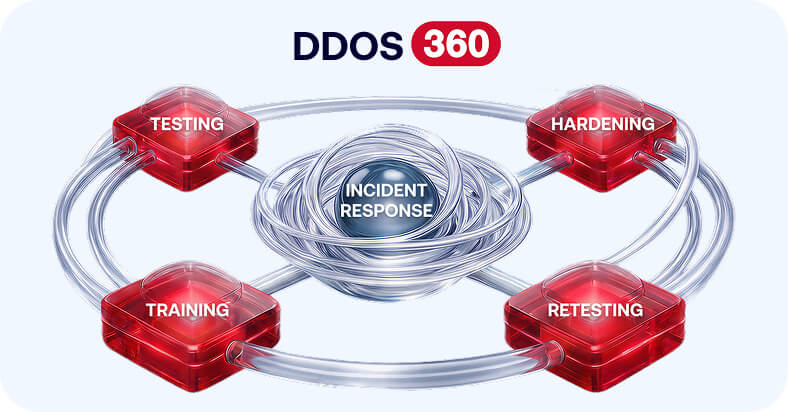
Type 1 and Type 2 vulnerabilities are entirely different. They do not have CVEs. They are highly specific to your unique infrastructure, configurations, and traffic patterns. The only way to find them is to reproduce the exact conditions under which they appear. This requires controlled simulations under realistic attack conditions, not simple architecture reviews or vendor dashboards.
Mythos gives us a clear reason to pay attention to that gap. The general AI reasoning improvements already underway are lowering the entry point and accelerating the path from vulnerability to exploit. We must close these gaps now, rather than waiting for the confirmation of an AI-orchestrated DDoS campaign to create urgency in retrospect.
About the author