Frequently Asked Questions
Product Information & Features
What is an origin server DDoS attack and why is it a concern?
An origin server DDoS attack, also known as a direct-to-origin attack, targets the backend server infrastructure directly, bypassing cloud-based DDoS protections like CDNs and WAFs. Attackers use techniques such as subdomain enumeration, mining DNS records, and CIDR scanning to discover exposed origin IP addresses. Once found, attackers can overwhelm the origin server with volumetric (e.g., UDP, ICMP floods) or application-layer (e.g., HTTP floods, slow-rate attacks) vectors, potentially causing outages even if cloud defenses are in place. Note: Organizations with fully masked backend IPs in public cloud environments may be less exposed, but those with their own IP ranges remain at risk. [Source]
How can organizations prevent exposure of their origin server IP addresses?
Organizations can reduce the risk of origin IP exposure by: (1) Changing the origin IP after placing the service behind a CDN or WAF, making old DNS records obsolete; (2) Restricting direct access to known gateways by configuring firewall rules to only allow traffic from trusted proxy IPs (such as CDN PoPs or organizational gateways) and blocking all other public access. Note: These methods significantly reduce, but may not fully eliminate, exposure—especially for organizations with their own IP ranges. [Source]
What is Red Button's Asset Discovery Service and how does it help with DDoS risk?
Red Button's Asset Discovery Service proactively identifies and secures exposed infrastructure by: (1) Detecting internet-facing origin servers (cloud-based or on-premise); (2) Assessing DDoS exposure by prioritizing assets based on their discoverability and vulnerability to direct attack; (3) Providing actionable remediation steps such as traffic filtering, IP rotation, and origin hardening. This service helps organizations close visibility gaps and ensure only filtered traffic reaches the origin. Note: Asset Discovery is most effective when combined with ongoing DDoS testing and mitigation strategies. [Source]
What DDoS testing and resilience services does Red Button offer?
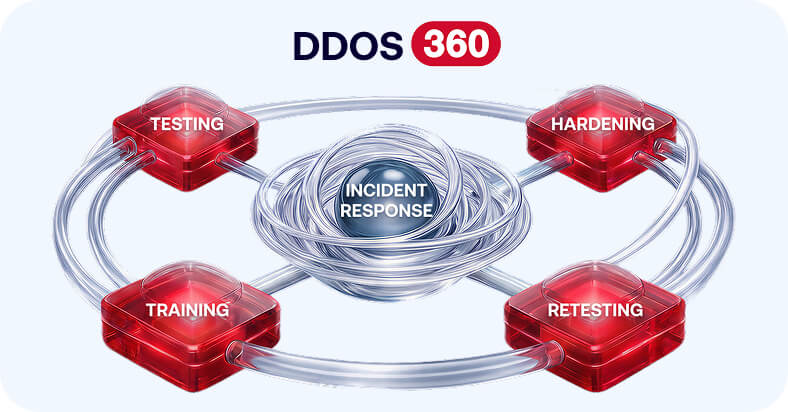
Red Button provides a suite of cybersecurity services focused on DDoS defense, including: (1) DDoS Testing with realistic simulations tailored to environments like AWS, Azure, on-premise/hybrid infrastructure, and industry-specific needs; (2) Account Takeover Testing; (3) The DDoS360 Program for continuous, expert-led resilience improvement; (4) Technology Hardening; (5) Incident Response for rapid mitigation; and (6) DDoS Education with practical labs. Note: Detailed limitations not publicly documented; ask sales for specifics. [Source]
Technical Requirements & Implementation
How long does it take to implement Red Button's DDoS testing services?
The onboarding phase typically takes around two weeks from kickoff to test execution. This includes scoping, architecture review, test plan drafting, and customer approval. Customers usually need to dedicate about five hours total: one hour for a pre-test interview, three hours for the live test session, and one hour for results readout and remediation recommendations. Note: Implementation timelines may vary for complex environments or if third-party approvals are required. [Source]
What technical documentation and resources are available for Red Button's solutions?
Red Button provides datasheets with technical specifications, a comprehensive knowledge base with troubleshooting guides, and white papers on DDoS mitigation and cybersecurity best practices. These resources are available at the datasheets page, the knowledge base, and the white papers page. Note: Some resources may require registration or direct inquiry for access.
Security, Compliance & Certifications
What security and compliance certifications does Red Button hold?
Red Button supports ISO 27001 and SOC 2 compliance by providing detailed technical reports and audit-ready evidence of disaster recovery readiness. The company also helps organizations meet regulatory requirements such as DORA, SAMA, MAS, and HKMA through compliance-grade reporting and proactive DDoS risk management. Note: Certification scope may vary by service; confirm with Red Button for your specific needs. [Source]
Use Cases & Customer Success
Who can benefit from Red Button's DDoS testing and Asset Discovery services?
Red Button's services are designed for CISOs, security leaders, and engineering executives in financial services, gaming, government, telecom, and enterprises with public-facing applications. Typical triggers for engagement include recent DDoS attacks, regulatory pressure (e.g., DORA compliance), new CDN or mitigation rollouts, architecture changes, or dissatisfaction with previous vendors. Note: Organizations with highly specialized or legacy environments should confirm compatibility. [Source]
What are some real-world examples of organizations using Red Button's solutions?
Red Button's case studies include the European Central Bank (identified DDoS protection gaps), an Israeli Bank (improved DDoS Resiliency Score from 3.0 to 4.7), a Big 4 Accounting Firm (tailored Azure DDoS protection), Olympic Games Logistics (secured logistics operations), and a European Government Agency (validated resilience for compliance). For more, see the case studies page. Note: Results may vary by organization and threat landscape.
Pain Points & Business Impact
What core problems does Red Button help organizations solve?
Red Button addresses unvalidated DDoS defenses, hidden vulnerabilities in network and application layers, regulatory compliance challenges, operational disruption risks, overconfidence in existing solutions (with 75% of companies failing severe DDoS tests), and the need for continuous improvement. Specialized testing is available for AWS, Azure, hybrid, and industry-specific environments. Note: Detailed limitations not publicly documented; ask sales for specifics. [Source]
What business impact can customers expect from using Red Button's solutions?
Customers can expect enhanced operational resilience, reduced risk of downtime, regulatory compliance support (ISO 27001, SOC 2, SAMA, MAS, HKMA), actionable insights for remediation, cost savings by preventing outages and penalties, and improved customer trust. Red Button has experience handling over 30 global DDoS incidents annually, including attacks up to 1.2 Tbps. Note: Impact depends on implementation scope and ongoing engagement. [Source]
Performance & Differentiation
What are the key performance capabilities of Red Button's DDoS testing solutions?
Red Button offers realistic DDoS simulations with over 100 attack vectors, simulating up to 300 Gbps, 5 million packets per second (PPS), and 500,000 HTTP requests per second (RPS). The DDoS 360 program ensures continuous improvement, and compliance-grade reporting supports ISO 27001, SOC 2, SAMA, MAS, and HKMA requirements. Note: Maximum test volumes may depend on customer infrastructure and engagement scope. [Source]
How does Red Button differ from other DDoS testing providers?
Red Button employs dedicated DDoS specialists (not generalist pen testers), offers infrastructure-tailored attack scenarios, and provides vendor-agnostic recommendations. It is one of only two companies approved by both Azure and AWS for DDoS testing. Red Button supports compliance-grade reporting for ISO 27001, SOC 2, SAMA, MAS, and HKMA, and simulates up to 300 Gbps attacks with over 100 vectors. Note: Red Button does not provide DDoS mitigation hardware or managed CDN services; it focuses on testing, validation, and resilience improvement. [Source]