

Why Your Once-a-Year DDoS Simulation May Leave You Vulnerable


Most security leaders believe that if they have the right protection technologies in place and successfully pass an annual DDoS simulation, they are adequately protected. Unfortunately, that assumption often proves incorrect.
In our experience, many organizations remain overconfident in their ability to withstand a real-world attack.
Even enterprises that have invested heavily in cloud DDoS protection, web application firewalls, CDNs, and managed security services frequently discover critical weaknesses when subjected to realistic attack conditions. A successful test performed months ago does not necessarily reflect the current state of the environment.
Annual DDoS testing is certainly better than no testing at all. However, security teams should recognize that a single point-in-time assessment only validates the environment as it existed on the day of the exercise. Modern IT environments change continuously, and every significant change introduces the possibility that previously validated protections are no longer functioning as intended.
The Velocity of Change: How IT Updates Create Security Risk
The challenge facing modern organizations is not simply the sophistication of attackers. It is the speed at which IT environments evolve.
Most enterprises today operate in a continuous deployment model. Applications are updated regularly, cloud resources are provisioned and retired automatically, infrastructure-as-code templates are modified, APIs are introduced, and network architectures evolve to support new business requirements. In many organizations, dozens or even hundreds of production changes occur every week.
Each of these changes has the potential to alter an organization’s DDoS security posture.
A seemingly routine application release may introduce a new endpoint that bypasses existing rate-limiting policies. A CDN configuration update may inadvertently expose an origin server that was previously protected. A firewall rule change may create an unexpected traffic path around established controls. Even a DNS modification can alter how mitigation services interact with production traffic.
The problem is not that organizations lack security controls. The problem is that the controls themselves are affected by the same operational changes occurring throughout the environment.
This phenomenon is often referred to as configuration drift. Over time, systems gradually diverge from the state that was originally tested and validated. A DDoS protection architecture that performed flawlessly during a simulation six months ago may now contain undocumented exceptions, temporary workarounds, new integrations, or altered traffic flows that significantly reduce its effectiveness.
The challenge becomes even greater in multi-cloud and hybrid environments. Security teams must maintain consistent protection across cloud providers, content delivery networks, SaaS services, API gateways, load balancers, and on-premises infrastructure. A change in any one of these layers can create unintended consequences elsewhere in the architecture.
This is why many organizations experience successful DDoS attacks despite having previously passed security assessments. The attack does not exploit a missing technology; it exploits the gap between a continuously changing environment and an infrequently validated security posture.
A DDoS simulation performed once per year provides valuable insight, but it cannot guarantee that the environment remains resilient throughout the other 364 days.
How the DDoS 360 Program Solves the “Stale Defense” Problem
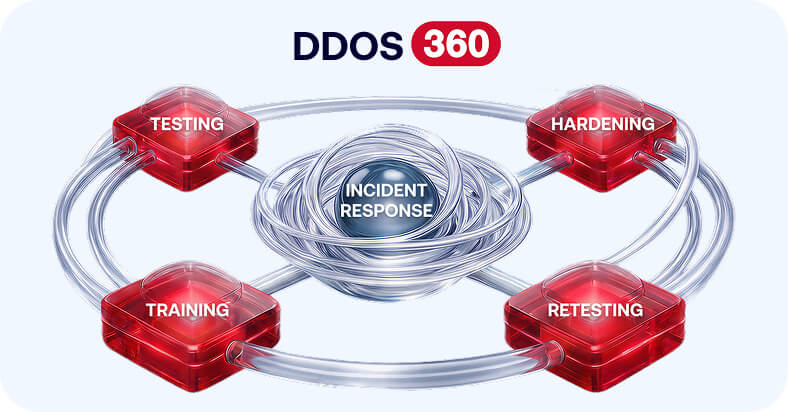
The DDoS 360 program is designed to address the gap between static validation and dynamic infrastructure. Rather than treating resilience as a yearly compliance exercise, the program establishes an ongoing cycle of testing, hardening, and verification.
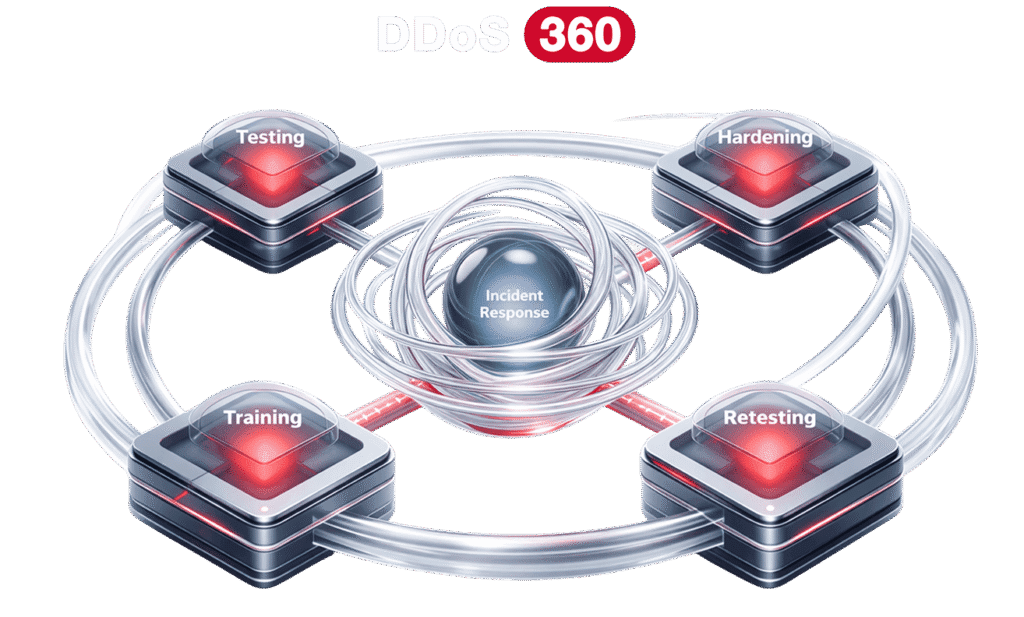
The process begins with expert-led simulations tailored to the organization’s architecture, traffic patterns, business applications, and threat landscape. Unlike generic automated assessments, these exercises are designed by specialists with experience mitigating real-world attacks across complex enterprise environments.
Following each assessment, organizations receive prioritized remediation guidance focused on the areas that will produce the greatest reduction in operational risk. Recommendations extend beyond simple findings and often include architectural improvements, vendor-specific tuning, traffic engineering adjustments, and mitigation strategy enhancements.
Perhaps most importantly, remediation is verified through retesting. Many organizations complete a security assessment, receive a report, and assume the recommended fixes were implemented correctly. The DDoS 360 methodology validates that assumption by repeating attack scenarios and confirming that the intended improvements actually produce measurable resilience gains.
The program also reduces operational burden on internal teams. Planning, execution, analysis, and validation activities are managed by experienced specialists, allowing security and infrastructure teams to remain focused on day-to-day operations while still benefiting from continuous resilience improvement.
DDoS 360 Real World Case Study
The value of continuous validation can be seen in the resilience improvement journey of a major North American sports and media organization.
An initial assessment in 2023 identified multiple weaknesses across AWS, Azure, and on-premises environments, including gaps in protection coverage and opportunities to improve defensive processes. Rather than treating the findings as a one-time exercise, the organization entered an ongoing cycle of testing, remediation, and revalidation.
Over the following year, multiple improvements were implemented, including Akamai Site Shield deployment to strengthen direct-to-origin protection and CDN caching optimizations designed to absorb high-volume attacks against static content.
These efforts produced measurable results. By mid-2024, the organization’s DDoS Resiliency Score (DRS) had improved substantially. More importantly, subsequent simulations in 2025 confirmed that previously identified attack paths had been successfully mitigated.
Attack traffic that had once reached origin infrastructure was effectively blocked, and services were able to withstand attack scenarios that had previously resulted in disruption.
The key lesson was not that a single test improved resilience. It was that continuous validation ensured improvements remained effective as the environment evolved.
Battle-Testing the Human Element
Technology alone does not determine the outcome of a DDoS attack. Operational readiness is equally important.
Successful incident response depends on clearly defined responsibilities, effective communication, and well-rehearsed procedures. Without regular practice, even experienced teams can struggle to make critical decisions under pressure.
Frequent simulations help security operations, network operations, and infrastructure teams develop familiarity with attack scenarios before a real incident occurs. Over time, response actions become repeatable, escalation paths become clear, and decision-making becomes faster and more confident.
As a result, a real DDoS attack becomes a managed operational event rather than an organizational crisis.
About the author