

Best Cyber Resilience Solutions for Financial Services in 2026

The threat landscape facing financial institutions has never been more hostile. In 2026, DDoS attacks targeting financial institutions increased 105% year-over-year — from 329 incidents in 2024 to 674 in 2025. Banks, payment processors, fintech platforms, and insurers are not just under pressure from regulators demanding demonstrable resilience; they are actively targeted by increasingly sophisticated, well-funded threat actors.
Here’s the challenge most security leaders don’t talk about loudly enough: the majority of financial institutions already run multi-layered protection stacks. The real gap isn’t tooling, but validation. Most of those stacks have never been tested under real attack conditions. Security teams are operating on the assumption that their investments work, without evidence that they do.
This guide cuts through that assumption. Below, we map the eight categories that make up a complete enterprise resilience stack for regulated financial institutions in 2026 — including the layer most organizations are missing entirely: readiness testing that proves the stack functions as intended.
Key Takeaways
- DDoS attacks against financial institutions increased 105% year-over-year, making resilience validation a board-level priority.
- Most financial organizations already have security tools in place, but few have tested whether those defenses work under real attack conditions.
- Modern cyber resilience requires layered capabilities across mitigation, observability, incident response, and readiness testing.
- Regulations such as DORA increasingly require evidence-based resilience testing, not just security tool adoption.
- This guide breaks down the eight essential layers of a modern cyber resilience stack for banks, fintechs, insurers, and payment platforms.
What “Cyber Resilience” Actually Means for Financial Services
Resilience is not the same as protection. Protection means preventing an attack from succeeding. Resilience means the ability to withstand an attack and recover full operations when mitigation is imperfect — because in the real world, mitigation sometimes is.
The distinction matters enormously for regulated institutions. The EU’s Digital Operational Resilience Act (DORA), which came into force for financial entities in January 2025, makes this explicit. Article 24 establishes a framework for digital operational resilience testing. It doesn’t ask whether firms have bought the right tools, but rather whether those tools demonstrably work. Under Article 26, significant financial entities are required to conduct Threat-Led Penetration Testing (TLPT), including realistic attack simulations against live production environments.
DORA compliance cyber resilience programs, therefore, cannot be satisfied by a vendor’s security SLA or a checkbox on a procurement form. They require evidence gathered through controlled, documented testing.
The second concept practitioners need to internalize is the enterprise resilience stack: no single platform covers all attack surfaces. A network-layer DDoS scrubbing service does not address application-layer Slowloris attacks. A SIEM does not inject chaos to expose single points of failure in your failover logic. An incident response platform does not validate whether your WAF rate-limit rules are correctly configured. Each tool covers a distinct layer — and gaps between those layers are where attackers operate.
How We Selected These Solutions
Every platform in this guide was evaluated against four criteria:
- Enterprise-grade capability — proven at scale in complex, high-availability environments
- Financial services relevance — deployed in banks, payment processors, insurers, and fintech platforms
- Regulatory environment fit — supports or directly contributes to compliance documentation under DORA, ISO 27001, SOC 2, or equivalent frameworks
- Distinct stack layer — no two tools here compete with each other; each occupies a specific and non-overlapping role
That final point deserves emphasis. This is not a vendor comparison. It is a map of complementary capabilities.
The 8 Best Cyber Resilience Solutions for Financial Services in 2026
| Category | Platform | Core Role in the Stack |
| DDoS Readiness Testing | Red Button | Validates the entire stack under real attack conditions |
| DDoS Mitigation | Cloudflare | Global anycast network, WAF, rate-limiting, bot management |
| Edge Security | Akamai | High-capacity scrubbing, Kona WAF, Prolexic |
| Enterprise Observability | Datadog | Infrastructure monitoring, APM, real-time alerting |
| SIEM & Security Analytics | Splunk | Log correlation, threat detection, compliance reporting |
| Chaos Engineering | Gremlin | Controlled fault injection for application resilience |
| Cloud-Native Resilience Testing | AWS FIS | Managed fault injection within AWS environments |
| Incident Response | PagerDuty | On-call management, escalation, post-mortem workflows |
Best DDoS Readiness Testing Platform — Red Button
Every other tool in this stack is a standing defense. Red Button is the only platform here whose primary function is to attack your own infrastructure (in a controlled, authorized, documented way), so you know whether those defenses are adequate before a real attacker finds out first.
Red Button specializes in DDoS simulation for financial services across all attack layers:
- volumetric floods designed to exhaust bandwidth,
- protocol attacks targeting TCP/IP state tables,
- application-layer DDoS attacks crafted to mimic legitimate HTTP traffic patterns and bypass rule-based defenses.
It is an official testing partner for both AWS and Azure, which means simulations can be conducted safely against live production environments without risking upstream provider intervention or violating terms of service.
The platform’s central output is the DDoS Resiliency Score (DRS) — a quantitative rating that benchmarks your current resilience against the financial industry standard. This score does something no manual audit can: it replaces subjective confidence with measurable, reproducible evidence.
On the compliance side, Red Button’s simulation methodology directly supports DORA Article 26 TLPT obligations, providing the documentation trail regulators and auditors require.
Case Study: Big 4 Accounting Firm (Azure)
A Big 4 accounting firm engaged Red Button to assess its DDoS posture on Azure. Its initial DDoS Resiliency Score was 1.5 — against a recommended benchmark of 5.5 for financial services organizations. The Azure DDoS Protection Plan performed as expected at the network layer, blocking all three volumetric attacks in the test sequence. But it failed to detect or mitigate any of the three application-layer attacks — because those attacks were indistinguishable from legitimate HTTP traffic at the network layer. Without application-layer defenses in place and properly configured, the firm was effectively blind to the most prevalent attack vector in the current threat landscape.
Post-remediation — after deploying Azure Front Door CDN and correctly configuring WAF rate-limit rules — the firm’s DRS rose to 5.0.
This is the case for readiness testing in one data point: a production environment, a leading cloud provider’s native protection, and a complete failure at the layer attackers prefer most.
Talk to a DDoS expert to assess how your current defenses perform under real-world attack conditions
Best DDoS Mitigation Platform — Cloudflare
Cloudflare operates one of the largest and most widely distributed security networks in the world, spanning more than 335 cities globally with 500 Tbps of mitigation capacity — 23 times larger than the biggest DDoS attack ever recorded.
For financial services organizations, the relevant capability set spans the full OSI stack. At the network and transport layers, Cloudflare’s Magic Transit provides DDoS protection and routing for IP infrastructure, with Advanced TCP and DNS Protection handling the most common volumetric and protocol-based vectors. At the application layer, Cloudflare’s WAF enforces OWASP Top 10 rulesets and custom rules updated continuously by Cloudflare’s security team — often before affected organizations have completed their own patch cycles. Bot Management applies ML-based heuristics to score every request in milliseconds, distinguishing automated attack traffic from legitimate users without the friction of CAPTCHAs.
Critically, Cloudflare’s threat intelligence is derived from its position processing roughly 20% of global internet traffic. Every attack attempt against any customer on the network improves detection for all others in real time.
In Q3 2025, Cloudflare blocked 8.3 million DDoS attacks — a 40% year-over-year increase — including hyper-volumetric assaults exceeding 22 Tbps. Banking and financial services remained among the most consistently targeted industries across every quarterly report.
However, mitigation alone is not enough. Read why DDoS mitigation fails without testing
Best Edge Security Platform — Akamai
Where Cloudflare provides broad, composable cloud-native security across application and network layers, Akamai’s architecture is built for a different profile: large financial institutions with high-volume, latency-sensitive traffic, complex content delivery requirements, and the need for dedicated high-capacity DDoS scrubbing.
Akamai’s Prolexic platform provides cloud-based DDoS scrubbing with significant mitigation capacity and a 24/7 Security Operations Command Center (SOCC) staffed by dedicated response specialists. This is a meaningful differentiator for institutions where the cost of latency during mitigation is measured in basis points or customer churn. Prolexic routes traffic through Akamai’s scrubbing infrastructure, removes attack traffic, and delivers clean traffic to the institution — with protection extended to the entirety of a network’s IP infrastructure, not just web-facing assets.
The Kona Site Defender WAF provides application-layer protection with adaptive rules that respond to emerging threats, while Akamai’s global CDN infrastructure underpins content delivery performance across geographically distributed user bases.
For large banks, payment networks, and financial infrastructure operators with complex multi-region architectures and strict latency budgets, Akamai’s combination of high-capacity scrubbing, dedicated SOC support, and CDN infrastructure addresses requirements that purely software-defined solutions may not.
Best Enterprise Observability Platform — Datadog
A DDoS attack you can’t see is a DDoS attack you cannot respond to effectively. Datadog provides the observability layer that makes the entire resilience stack coherent — surfacing what is actually happening across infrastructure, applications, and services in real time.
For financial services security teams, Datadog’s value during and after an attack is specific: it provides the visibility to distinguish a DDoS-induced degradation from a configuration error, a capacity constraint, or a concurrent application failure. Its Application Performance Monitoring (APM) traces requests end-to-end across distributed systems, surfacing anomalous latency spikes and error rate increases that precede or accompany attacks but may not trigger network-layer alerts. Infrastructure monitoring captures CPU, memory, network I/O, and connection metrics across cloud and on-premises environments simultaneously.
The platform’s real-time alerting — with configurable thresholds and integrations into PagerDuty, Slack, and incident management workflows — means the signal from a developing attack reaches the right people before it becomes a disruption. Post-incident, Datadog’s log management provides the timeline reconstructions that DORA, ISO 27001, and SOC 2 auditors require.
Best SIEM and Security Analytics Platform — Splunk
Where Datadog provides real-time infrastructure and application observability, Splunk’s role in the enterprise resilience stack is broader and more analytical: aggregating log and event data across the entire security landscape, correlating signals from disparate sources, and producing the compliance-grade audit trails that regulated financial institutions are required to maintain.
For SIEM in financial services, Splunk’s core capability is correlation — the ability to connect a spike in failed authentication attempts, an anomalous DNS query pattern, and an upstream traffic increase into a coherent attack narrative that no individual tool would surface on its own. Security teams operating in complex hybrid environments, where attack signals are distributed across on-premises systems, cloud platforms, and third-party services, rely on Splunk’s aggregation layer to establish what happened, in what sequence, and across which systems.
The compliance dimension is equally significant. DORA requires detailed documentation of ICT-related incidents. ISO 27001 and SOC 2 audits require demonstrable logging practices and evidence of security monitoring. Splunk’s reporting and dashboarding capabilities are designed for exactly these audit workflows, generating the documentation that transforms security operations from a cost center into a compliance asset.
Best Enterprise Chaos Engineering Platform — Gremlin
Most resilience testing happens after an incident. Chaos engineering inverts that logic: you inject failures deliberately, in controlled conditions, before attackers or infrastructure failures do it for you.
Gremlin provides enterprise-grade fault injection across the full range of failure modes financial services infrastructure is vulnerable to: CPU saturation, network latency injection, packet loss, state corruption, and dependency failures. For application-layer DDoS resilience specifically, Gremlin allows engineering teams to simulate the degraded conditions a sustained attack creates — not the attack traffic itself, but the downstream effects on application performance, queue depths, database connection pools, and failover logic — and observe whether the system responds as designed.
This is where chaos engineering banking applications reveals problems that functional testing misses. A payment processing service might handle 10× normal transaction volume perfectly in load testing, but silently queue and then drop transactions when a downstream dependency degrades under attack-induced latency. Gremlin surfaces those failure modes before they become customer-facing incidents.
Best Cloud-Native Resilience Testing Platform — AWS Fault Injection Service (FIS)
For financial institutions running significant workloads on AWS, AWS Fault Injection Service (FIS) provides managed chaos engineering within the AWS environment — injecting faults directly into EC2 instances, ECS containers, RDS databases, and other AWS-native services without requiring third-party agents or external tooling.
The primary use case for security architects is validating the AWS-native resilience features that underpin availability commitments: auto-scaling behavior under load, failover timing for Multi-AZ RDS deployments, spot instance interruption handling, and the behavior of application tiers when individual components degrade. These are the failure modes that a volumetric DDoS attack — or a mitigation response that temporarily reroutes traffic — can expose in production.
AWS FIS integrates directly with AWS native tooling, including AWS CloudWatch for observability and AWS Systems Manager for orchestration, and pairs directly with Red Button’s authorized AWS DDoS simulation program. Together, the two platforms address both the attack simulation layer (Red Button) and the infrastructure fault injection layer (AWS FIS) — covering the full scope of DORA Article 25 ICT continuity testing obligations for AWS-hosted workloads.
Best Incident Response Platform — PagerDuty
Detection and mitigation without coordinated human response is incomplete. When a DDoS attack begins degrading services, the sequence of decisions in the first five to fifteen minutes — who is notified, in what order, with what authority to act — determines the difference between a contained incident and a material disruption.
PagerDuty provides the on-call management, automated escalation, and incident coordination infrastructure that translates real-time alerts from Datadog, Splunk, and the mitigation layer into organized human response. Its on-call scheduling ensures the right team members are reachable at any hour. Escalation policies ensure that if a primary responder is unreachable, the alert doesn’t die in an inbox. Incident coordination workflows keep security, engineering, and communications teams synchronized during active events.
The post-mortem function is equally important for regulated institutions. PagerDuty’s incident timeline documentation — capturing who was notified, when they acknowledged, and what actions were taken — provides the chronological audit trail that DORA incident reporting and internal governance frameworks require.
A Red Button case study from a Latin American bank illustrates what proper incident response coordination means at scale. During a 60 Gbps ransom DDoS attack, the bank experienced a 15-minute service outage — because no coordinated incident response protocol existed. When a second identical attack followed, pre-established protocols enabled the team to contain the incident with zero service disruption.
How These Solutions Work Together
The value of this stack is not additive — it is multiplicative. Each layer assumes the others are functioning, and the absence of any one creates a gap that adversaries will find.
| Phase | Tool(s) | Role |
| Prevent | Cloudflare / Akamai | Edge mitigation, WAF, scrubbing — stops attack traffic before it reaches infrastructure |
| Prevent | AWS FIS / Gremlin | Resilience fault injection — ensures systems survive what mitigation misses |
| Detect | Datadog / Splunk | Real-time observability and SIEM — surfaces attack signals and correlates them across layers |
| Respond | PagerDuty | Incident escalation and coordination — ensures the right people act within the right timeframe |
| Validate |
Red Button | Controlled DDoS simulation — proves the entire stack functions under real attack conditions |
The critical observation here is the direction of dependency. Prevent, Detect, and Respond tools only function as intended if they have been correctly configured, integrated, and tested. Red Button’s validation layer is what converts an assumed stack into a proven one. It is also the layer that produces the evidence documentation DORA and internal risk governance require — not as a byproduct, but as a primary deliverable.
Key Considerations for Financial Services Teams
DORA compliance documentation
DORA Articles 25 and 26 create specific obligations for ICT continuity and threat-led penetration testing. Red Button’s simulation reports provide the documented evidence of resilience testing that directly supports regulatory submissions. For EU-regulated financial entities, this is not optional — and the testing must be conducted against live production environments, not staging.
Hybrid and multi-cloud complexity
Most large financial institutions operate simultaneously across on-premises infrastructure, AWS, Azure, and in many cases private cloud or co-location environments. A DDoS attack does not respect architectural boundaries: application-layer attacks may arrive via paths your network-layer scrubbing service never sees. The testing program must cover all layers across all environments, not just the most visible ones.
Testing frequency
Annual DDoS readiness testing should be the baseline minimum. Testing should also be triggered by any significant infrastructure change — cloud provider migration, WAF reconfiguration, CDN provider change, network architecture redesign — because any of these can silently introduce gaps in the protection posture that only a controlled simulation will expose. The Big 4 accounting firm case study above is a precise example: Azure DDoS Protection was in place and working correctly at the network layer. The gap was at the application layer, and it would have remained undetected without testing.
Validation as a continuous practice
The most important mindset shift for security architects is treating validation not as a project but as a standing operational practice. Threat actors test your defenses continuously. Your program should too.
Conclusion: Resilience Is a Validated State, Not a Product Purchase
Investment in financial services cybersecurity has never been higher. The number of capable, enterprise-grade tools available to CISOs and security architects has never been greater. And yet attacks are increasing — 105% year-over-year for DDoS alone — and incident reports continue to demonstrate that protection tools are regularly deployed without being properly validated.
Cyber resilience for financial services is not achieved at the point of purchase. It is achieved (and maintained) through a disciplined combination of layered defenses, observable infrastructure, coordinated response, and rigorous testing that proves all of the above functions under real attack conditions.
The eight categories mapped in this guide form that complete stack. Each one is necessary. None is sufficient on its own. And without the validation layer — without DDoS testing for financial services conducted under controlled, realistic attack conditions — the rest of the stack is a hypothesis, not a capability.
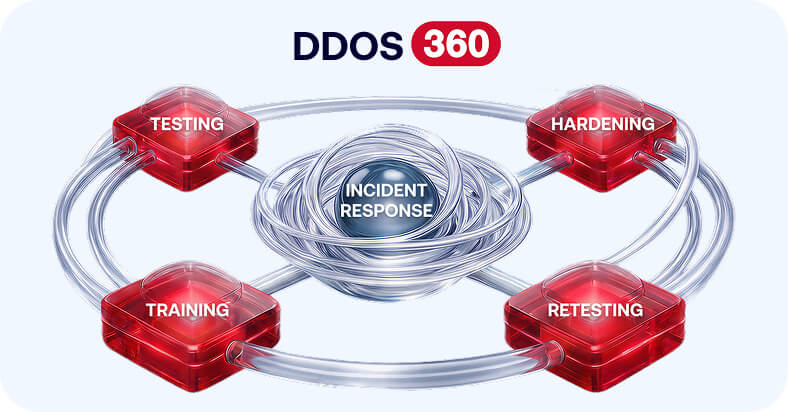
To understand where your current stack stands, start with the DDoS Resiliency Score framework, or explore how Red Button’s DDoS360 program integrates continuous readiness validation into an enterprise security program.
Connect with DDoS experts to run a controlled simulation and see how your defenses perform under real attack conditions.
FAQs
What is cyber resilience in financial services?
Cyber resilience is the ability of financial institutions to maintain and restore critical operations during and after cyberattacks, even when prevention and mitigation are not fully effective.
What is the difference between cybersecurity and cyber resilience?
Cybersecurity focuses on preventing attacks, while cyber resilience focuses on ensuring systems continue operating and recover quickly when attacks or failures occur.
Why is DDoS testing important for financial institutions?
Because it validates whether existing security and mitigation tools actually work under real attack conditions, helping identify gaps before attackers exploit them.
What is Threat-Led Penetration Testing (TLPT) under DORA?
TLPT is a regulatory requirement under DORA that mandates realistic, attack-simulated testing of critical systems in production-like environments to prove operational resilience.
How often should financial institutions test their cyber resilience stack?
At minimum annually, and additionally after any major infrastructure, cloud, or security configuration changes to ensure no new gaps are introduced.
About the author