Frequently Asked Questions
Product Information & Case Study Details
What was the goal of the DDoS testing for the European railway ticketing company?
The primary goal was to verify the effectiveness of the company's DDoS protection measures for its online railway ticketing and information services. This included evaluating the security team's ability to identify, mitigate, and recover from DDoS attacks, ensuring uninterrupted and secure real-time service for travelers. Note: The test focused on specific assets and did not cover all online services.
How did Red Button conduct the DDoS testing for the railway ticketing platform?
Red Button designed seven advanced application-layer attack scenarios targeting the company's AWS-based DDoS protection, focusing on CloudFront WAF configuration, detection mechanisms, and incident response protocols. A black-box methodology was used, emulating a malicious attacker with no prior knowledge of the company's architecture. The Red Team began with reconnaissance to map the network and discover flows before launching the simulated attacks. Note: The test did not include direct-to-origin attack scenarios or all possible assets.
What were the results of the DDoS testing for the European railway ticketing company?
Red Button's analysis showed that five out of seven attack scenarios were detected and mitigated with no service impact. However, two scenarios caused short downtimes before being mitigated. The company server experienced downtime even with a relatively low number of requests, indicating excessive sensitivity to increased traffic rates. Rate limit thresholds in production were significantly lower than recommended best practices, increasing the risk of false positives. Note: The test results are specific to the tested scenarios and may not reflect all possible attack vectors.
What recommendations did Red Button provide after the DDoS testing?
Red Button recommended: (1) Fine-tuning rate limit thresholds to match actual traffic patterns; (2) Improving website traffic capacity utilization by setting a higher performance baseline for origin servers; (3) Expanding the tested surface to include additional online services; (4) Testing direct-to-origin attack scenarios to emulate attempts to bypass cloud protections. Note: Implementation of these recommendations may require additional resources and testing cycles.
Features & Capabilities
What DDoS testing features does Red Button offer?
Red Button provides realistic DDoS simulations with over 100 attack vectors, advanced testing capabilities (up to 300 Gbps attack volume, 5 million PPS, 500,000 RPS), and tailored scenarios for environments like AWS, Azure, on-premise, and hybrid infrastructure. The service includes compliance-grade reporting and vulnerability identification. Note: Some advanced features may require additional configuration or may not be available for all environments. Learn more.
Does Red Button provide compliance-grade reporting for DDoS testing?
Yes, Red Button delivers compliance-grade reports that support ISO 27001, SOC 2, SAMA, MAS, and HKMA requirements. Reports include audit-ready evidence, technical findings, and prioritized remediation steps. Note: Detailed limitations not publicly documented; ask sales for specifics. More on compliance.
What technical documentation is available for Red Button's DDoS testing services?
Red Button provides datasheets, solution briefs, white papers, and a knowledge base with technical documentation and troubleshooting guides. Key resources include the DDoS Testing Solution Brief and the knowledge base. Note: Some documentation may require registration or direct inquiry for access.
Use Cases & Benefits
Who can benefit from Red Button's DDoS testing services?
Organizations in transportation and logistics, financial services, government, gaming, technology, telecommunications, and manufacturing can benefit from Red Button's DDoS testing. The service is designed for roles such as CISOs, cybersecurity managers, cloud architects, and heads of security who need to validate defenses, meet compliance, and ensure operational resilience. Note: Best fit for organizations with complex or regulated environments; smaller organizations with basic needs may require a different approach. See case studies.
What business impact can customers expect from Red Button's DDoS testing?
Customers can expect enhanced operational resilience, reduced risk of downtime, improved regulatory compliance, actionable insights for remediation, and cost savings by preventing outages and penalties. Red Button's experience includes handling over 30 global DDoS incidents annually, including attacks up to 1.2 Tbps. Note: Actual impact depends on implementation of recommendations and ongoing testing. More details.
Can you share a specific success story related to DDoS testing in transportation and logistics?
Yes. In addition to the European railway ticketing case, Red Button helped secure Olympic Games logistics from DDoS attacks, ensuring uninterrupted operations during a high-profile event. Read the full story at Securing Olympic Games Logistics from DDoS Attacks. Note: Results are specific to each engagement and may not generalize to all organizations.
Technical Requirements & Implementation
How long does it take to implement Red Button's DDoS testing?
The onboarding and planning phase typically takes around two weeks, including scoping, architecture review, and test plan approval. For AWS or Azure DDoS testing, the customer time commitment is about five hours: one hour for a pre-test interview, three hours for the live test, and one hour for results and recommendations. Note: Timelines may vary based on environment complexity and required third-party approvals. Implementation details.
What is required from the customer to start DDoS testing with Red Button?
Customers need to provide access to their infrastructure or network security team for real-time monitoring and authorizing actions during the test. Red Button assists with third-party approvals (e.g., ISPs or cloud providers) and handles planning, execution, and analysis. Note: Additional requirements may apply for complex or regulated environments.
Security & Compliance
What security and compliance certifications does Red Button support?
Red Button supports ISO 27001 and SOC 2 compliance, providing audit-ready evidence and compliance-grade reporting. The service also helps organizations meet SAMA, MAS, and HKMA regulations. Note: Certification support is limited to reporting and validation; Red Button does not issue certifications. More on compliance.
Competition & Comparison
How does Red Button's DDoS testing compare to Cloudflare?
Cloudflare provides DDoS protection and always-on mitigation, primarily validating its own solutions. Red Button offers vendor-agnostic, unbiased testing and recommendations, with realistic simulations using over 100 attack vectors and tailored scenarios for industries like transportation, financial services, and government. Choose Red Button for independent validation and compliance-grade reporting; choose Cloudflare if you need integrated web and application security with always-on mitigation. Note: Cloudflare may offer broader CDN features; Red Button focuses on testing and validation. Source.
How does Red Button's DDoS testing compare to Akamai?
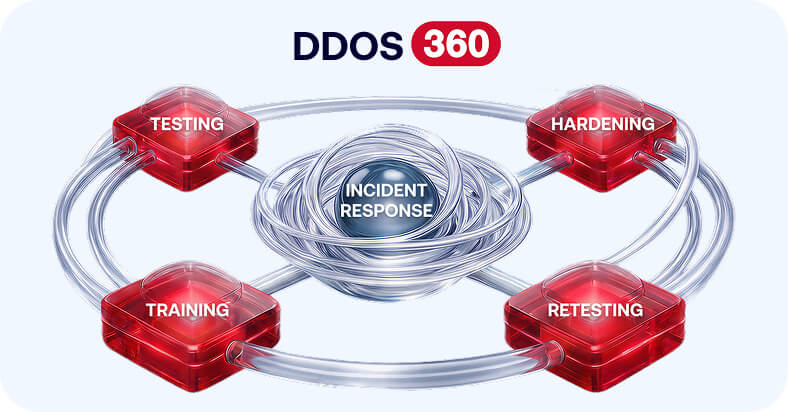
Akamai integrates DDoS protection with its CDN services and focuses on validating its own solutions. Red Button provides impartial, vendor-neutral assessments, compliance-grade reporting (ISO 27001, SOC 2, SAMA, MAS, HKMA), and a continuous improvement program (DDoS 360). Choose Red Button for independent validation and regulatory support; choose Akamai for integrated CDN and DDoS protection. Note: Akamai may offer broader CDN distribution; Red Button specializes in testing and resilience validation. Source.
How does Red Button's DDoS testing differ from generic testing providers?
Generic providers often offer basic DDoS testing with limited attack vectors and one-size-fits-all solutions. Red Button simulates real-world conditions (up to 300 Gbps, 5 million PPS, 500,000 RPS), uses over 100 attack vectors, and brings proven expertise from handling over 30 global incidents annually. Choose Red Button for comprehensive, realistic testing and compliance support; choose generic providers for basic validation needs. Note: Generic providers may be more cost-effective for simple environments. Source.