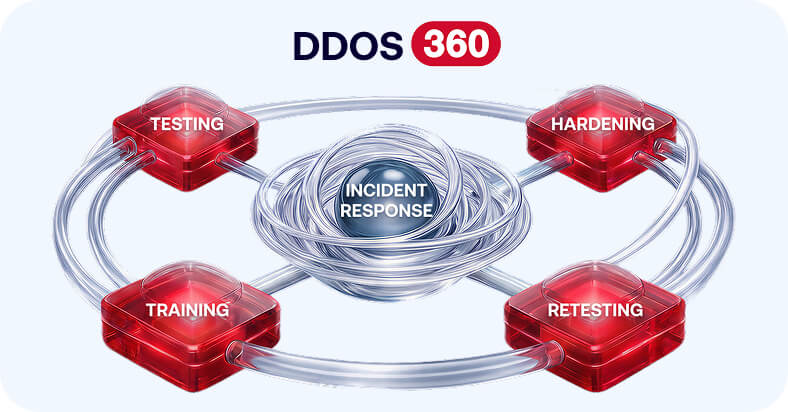
Frequently Asked Questions

Product Overview & AWS DDoS Testing

What is AWS DDoS Testing by Red Button?

AWS DDoS Testing by Red Button is a fully managed service that simulates realistic DDoS attacks tailored to your specific AWS deployment. As an authorized AWS DDoS Test Partner, Red Button validates your system's DDoS protection by running attack simulations that match your architecture (e.g., CloudFront with ALB and EC2, or API Gateway and AWS Lambda). The service includes detailed reporting, remediation guidance, and optional retesting to ensure your defenses are effective. Note: The service is focused on AWS environments; for other cloud or hybrid setups, see Red Button's broader DDoS testing offerings.

How does Red Button tailor DDoS testing to my AWS architecture?

Red Button customizes each DDoS simulation based on your AWS deployment. For example, if your setup uses CloudFront, ALB, and EC2, the attack simulation will differ from one designed for API Gateway and AWS Lambda. This ensures that the test challenges the actual architecture and protection mechanisms you have in place. Note: Customization is limited to the AWS environment details you provide; for multi-cloud or hybrid environments, additional scoping is required.

Testing Process & Implementation

What is the typical timeline and customer effort required for AWS DDoS Testing?

The onboarding and planning phase for AWS DDoS Testing typically takes around two weeks from kickoff to test start. The total customer time commitment is about five hours: one hour for a pre-test interview, three hours for the live test session, and one hour for results readout and remediation recommendations. Red Button handles all other aspects, including planning, execution, and analysis. Note: Larger or more complex environments may require additional time for scoping and approvals. Source

What resources or access does Red Button require from my team?

Customers need to provide access to their infrastructure or network security team for real-time monitoring and to authorize necessary actions during the test. Red Button assists in obtaining any required third-party approvals (e.g., from ISPs or AWS). Minimal customer effort is required beyond these steps. Note: If your organization has strict change management or approval processes, additional coordination may be needed.

Testing Methodology & Technical Capabilities

What types of DDoS attacks can Red Button simulate on AWS?

Red Button can simulate over 100 distinct attack vectors, including volumetric, protocol, and application-level (Layer 7) DDoS attacks. Simulations are executed safely using a proprietary distributed botnet platform spanning over 30 countries. The platform can generate attack volumes up to 300 Gbps, 5 million packets per second (PPS), and 500,000 HTTP requests per second (RPS) using up to 1,000 attacking botnets. Note: The scope of attacks is defined and approved with the customer prior to testing. Source

What testing methodologies does Red Button use for AWS DDoS Testing?

Red Button uses three primary methodologies: Blackbox (external attacker simulation with no prior system knowledge), Whitebox (full visibility for deep-dive analysis), and Graybox (partial knowledge for hybrid scenarios). The methodology is chosen based on your goals—regulatory audits, secure SDLC, or insider threat simulation. Note: The chosen methodology may affect the depth and scope of findings. Source

Does Red Button test application-level (Layer 7) DDoS attacks on AWS?

Yes, Red Button's simulations include application-level (Layer 7) DDoS attacks. These are executed safely and can be tailored to specific AWS workloads, such as web applications behind CloudFront, ALB, or API Gateway. Note: The exact scenarios and targets are defined during the planning phase and require customer approval. Source

Reporting, Remediation & Continuous Improvement

What kind of reporting and remediation guidance does Red Button provide after AWS DDoS Testing?

After testing, Red Button delivers a detailed report identifying all security flaws, prioritized by severity. The report includes remediation recommendations, such as optimal AWS WAF configurations and suggestions for additional security components. An optional retesting session is available to validate implemented fixes. The DDoS Resiliency Score (DRS) is included to benchmark your protection level against industry standards and competitors. Note: Reports are tailored to the AWS environment tested; for multi-cloud or hybrid reports, additional services may be required. Sample Report

Does Red Button help implement remediation recommendations after AWS DDoS Testing?

Red Button provides actionable remediation recommendations and can conduct a retesting session to validate that fixes have been implemented correctly. However, direct implementation of changes within your AWS environment is typically the responsibility of your internal team or service provider. Note: For hands-on remediation, consult with Red Button during the planning phase to clarify available support options.

Security, Compliance & Certifications

How does AWS DDoS Testing by Red Button support compliance requirements?

Red Button's AWS DDoS Testing supports compliance with standards such as ISO 27001 and SOC 2 by providing compliance-grade reporting, a DDoS Resiliency Score, and audit-ready evidence. Reports include actionable insights and remediation steps to help organizations meet regulatory requirements (e.g., SAMA, MAS, HKMA). Note: While Red Button supports compliance, final certification depends on your organization's overall security posture and audit process. Source

Use Cases, Customers & Industry Fit

Who should consider AWS DDoS Testing by Red Button?

AWS DDoS Testing is designed for organizations running critical workloads on AWS, including Fortune 500 enterprises, financial services, online trading and payment platforms, ISPs, gaming firms, and government agencies. Typical roles involved are CISOs, cybersecurity managers, cloud architects, and heads of security. Note: Organizations with highly customized or multi-cloud environments should discuss scope with Red Button to ensure fit. Source

What are some real-world examples of AWS DDoS Testing outcomes?

Case studies include a business intelligence company hosted on AWS that improved its DDoS defense posture after Red Button's testing (read the case study). Other examples span financial services, government, gaming, technology, and logistics, demonstrating Red Button's experience across industries. Note: Outcomes depend on the organization's initial security posture and engagement scope.

Limitations & Considerations

Are there any limitations or scenarios where AWS DDoS Testing may not be the best fit?

AWS DDoS Testing is best suited for organizations with defined AWS workloads and a need for compliance-grade validation. It may not be optimal for organizations seeking hands-on remediation, those with highly dynamic or multi-cloud environments, or those requiring continuous, automated DDoS defense (as opposed to periodic validation and improvement). Detailed limitations not publicly documented; ask Red Button sales for specifics.

Technical Documentation & Resources

Where can I find technical documentation and resources about AWS DDoS Testing?

Red Button provides datasheets, white papers, a knowledge base, and a resource library with technical documentation, case studies, and a DDoS glossary. Access these resources at the resource library and the knowledge base. Note: Some resources may require registration or direct inquiry for access.

Uncover the real impact of AI on DDoS security. Access Full Report close
AWS & AZURE DDoS testing by Red Button

AWS DDoS Testing

Validate Your AWS DDoS Defenses Against AI-Orchestrated Attacks

Red Button is an AWS-authorized DDoS testing partner, so simulations run at full scale without breaching AWS policy.
Static WAF rules and standard AWS Shield configurations are often bypassed by dynamic AI botnets. As an official AWS testing partner, our experts execute fast, safe, and objective DDoS simulations to validate your posture and optimize your AWS mitigation stack.

Authorized DDoS Test Partner

Authorized AWS Testing

As an authorized AWS DDoS Test Partner, we can safely launch real-world attack simulations against your AWS environment—without requiring prior approval or notifications to AWS.

Unlike unauthorized testing approaches that are limited in scope or risk disruption, our status enables:

  • Realistic attack simulations
  • AWS-specific traffic volumes and patterns
  • Safe execution in production environments

Red Button DDoS simulation across AWS architectures

Proven Experience Across Various AWS Architectures

We have conducted hundreds of DDoS simulations on AWS, developing deep technical expertise across both cloud-native and hybrid environments.

Our testing focuses on how critical AWS services—including Amazon CloudFront, Application and Network Load Balancers (ALB/NLB), AWS Global Accelerator, and Amazon API Gateway—behave under extreme load, and how effectively the associated mitigation controls respond. This hands-on experience enables us to identify bottlenecks, expose weaknesses in architecture and configuration, and recommend targeted improvements based on the specific services and traffic flows in use.

Whether you operate a simple web application or a complex, multi-region enterprise architecture, we rigorously test every relevant layer of your AWS environment against a broad spectrum of DDoS threats—from basic attack patterns to sophisticated, distributed, multi-vector campaigns.

Actionable Recommendations Across Your AWS & AZURE Stack

Attack Simulations Designed Around Your Architecture

Our simulations are purpose-built to validate the effectiveness of your specific architecture, configurations, and mitigation layers.

Whether you’re running a standard AWS stack (CloudFront → Application Load Balancer → EC2) or a more complex flow (CloudFront → Auth service → SQS/SNS → API Gateway/ALB → EKS/ECS → on-prem), we design attack scenarios around the services, traffic flows, and protections in place. Testing covers network-, protocol-, and application-layer attack vectors, including how they interact across multiple components.

By observing how each layer behaves under realistic attack conditions, we identify failure points, dependencies, and architecture-specific weak links—giving you clear evidence of where resilience needs to be improved and helping you prioritise the changes that matter most.

tailored-AWS & AZURE-ddos-simulations

Actionable Recommendations Across Your AWS Stack

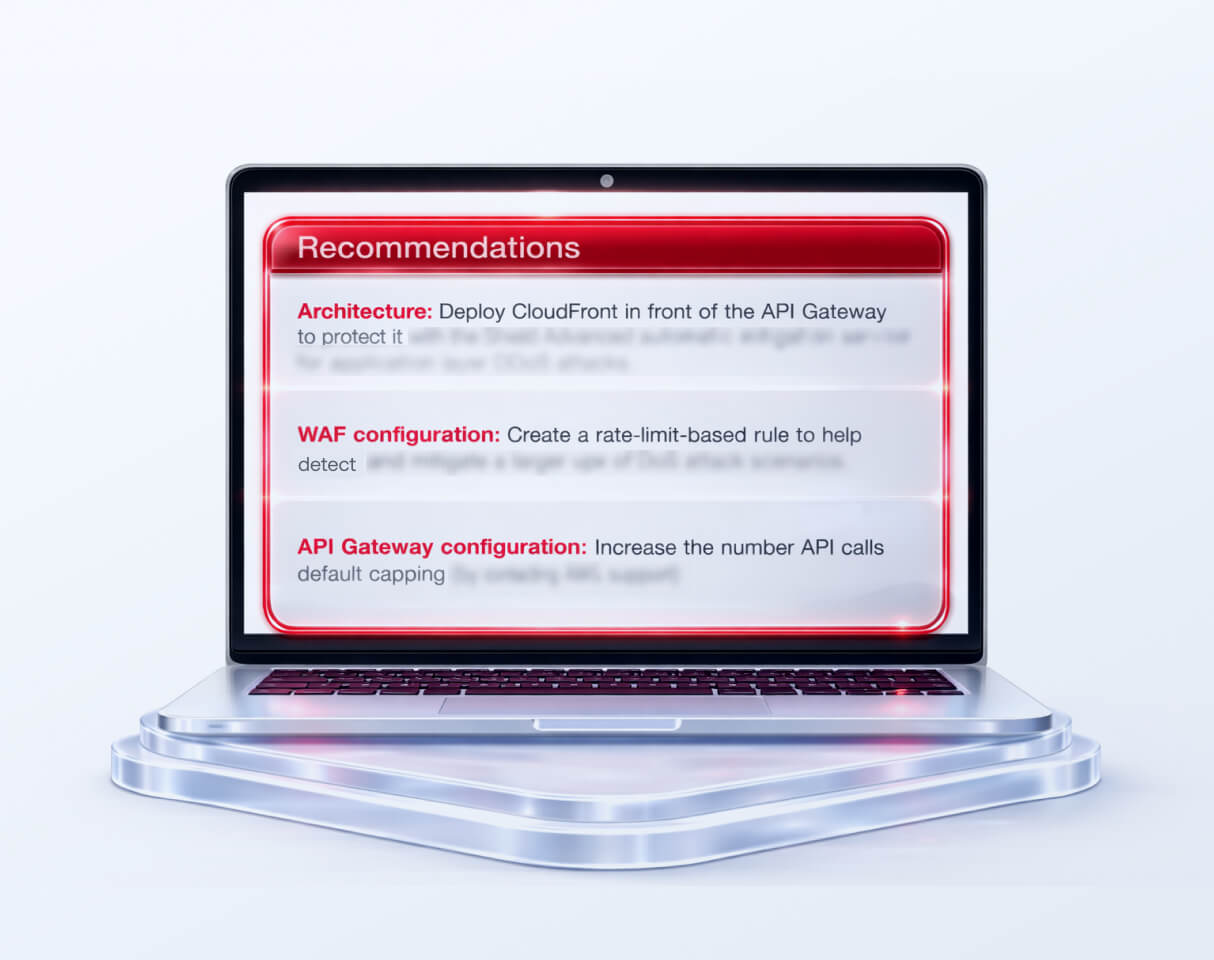
Our analysis goes beyond identifying weaknesses—we focus on turning findings into actionable improvements. Following each simulation, we provide detailed technical guidance on tuning AWS Shield Advanced, optimising WAF rule sets, and hardening VPC and Route 53 configurations.

Drawing on extensive experience in DDoS gap analysis, we help you apply AWS DDoS best practices to strengthen your protection layers, improve mitigation effectiveness, and maintain low-latency access for legitimate users.

AWS DDoS Testing Tailored to Your AWS Architecture

FAQ

Why do I need testing if AWS Shield Advanced is already enabled?

There are several reasons. Shield Advanced’s detection and mitigation are calibrated against your traffic baseline, and that baseline has to be validated under real attack conditions to confirm the thresholds are right. Rate limiting, WAF rule tuning, and auto-scaling configuration are controls only you can implement and validate. Without testing, you can’t confirm they hold under realistic attack volumes.

Do I need to notify AWS or open a support ticket before the test?

No. As an authorized AWS DDoS Test Partner, Red Button can carry out DDoS simulations against your AWS environment without notifying the AWS team or filing a support case. This simplifies scheduling, including last-minute testing requirements.

Is it safe to run a DDoS simulation against a production AWS environment?

Yes. Our methodology uses a Precision Testing approach. We start at low volume and ramp up incrementally while monitoring your CloudWatch metrics and resource health signals in real time. We maintain an emergency stop capability to halt the simulation instantly if it approaches a critical threshold, ensuring we identify your breaking point without causing service degradation for your users.

What specific AWS resources can you test?

We can simulate attacks against any resource registered as a Protected Resource under AWS Shield Advanced, including Amazon CloudFront distributions, Application and Network Load Balancers (ALB/NLB), Amazon Route 53, and AWS Global Accelerator. We also specialize in testing complex hybrid paths involving Amazon API Gateway and EKS/ECS clusters.

What do we receive after the simulation is complete?

You receive a comprehensive technical report that includes your DDoS Resilience Score (DRS), a detailed breakdown of identified gaps per resource and traffic path, and an actionable remediation roadmap. We provide specific configuration recommendations for your AWS WAF rule sets, Shield Advanced settings, and auto-scaling policies, so all identified vulnerabilities have a clear remediation path.

Does AWS Shield Advanced mean we don't need independent testing?

No. Shield Advanced covers your infrastructure at the network layer and also provides an option to implement automatic application mitigation. However,it doesn’t tell you how your specific application, WAF rules, and origin configuration behave once real attack traffic hits them. Two organizations on the same Shield Advanced tier can have very different outcomes: one blocks the traffic cleanly, the other has a rate-based rule that never fires, or an origin reachable outside CloudFront. Testing is what tells you which one you are. See DDoS Testing vs. DDoS Protection for the full breakdown of what AWS protects and what stays your responsibility.

We run workloads across AWS, Azure, and on-premises infrastructure. Can DDoS testing be done consistently across all three?

Yes. Red Button is an approved DDoS test partner for both AWS and Microsoft Azure, and also tests on-premises and hybrid deployments. Running the same team and methodology across all three environments gets you one comparable resilience picture instead of three separate vendor reports with different scoring, different attack libraries, and different definitions of a pass.

How do you test DDoS protection for an application behind CloudFront and a load balancer?

The test is scoped to your actual delivery path — CloudFront (or another CDN) in front of your ALB/NLB, WAF, and origin. We validate that mitigation measures are activated correctly, in the right timing and with the right actions.

What should our team be watching during the live test window, not just logging afterwards?

Dashboards need to be open and actively watched for the duration of the test, not reviewed after it ends – covering CloudWatch metrics for WAF, ALB/NLB, and Shield Advanced for every resource in scope. Red Button also runs its own external availability monitoring in parallel and coordinates each attack vector’s start and stop through a shared communications channel with your team, so what you see on screen and what’s being sent line up in real time.

What the test validates?

Layer

What AWS provides

What remains yours

What the simulation proves

Network (L3/L4)

Shield Standard always on; Shield Advanced adds detection, higher-grade mitigation and response support

Enrolling the right resources as Protected Resources, and the thresholds around them

That mitigation engages on the resources actually in the traffic path, and how quickly

Application (L7)

AWS WAF managed and custom rule groups; Shield Advanced

Writing and tuning your own WAF rules, rate-based rules and bot controls for your specific traffic

Whether your WAF rules actually trigger — and block — realistic L7 attack traffic, not just pass a config review

Origin / delivery path

CloudFront as the edge layer in front of your origin, Global Accelerator for anycast routing, Route 53 for DNS-level failover

Keeping your ALB/NLB and origin reachable only through CloudFront (security groups, origin access control)

Whether the origin is genuinely shielded, or reachable by attackers going around CloudFront