Frequently Asked Questions

Product Information & Case Study Insights

What was the main objective of the DDoS resilience validation for the European government agency?

The primary objective was to evaluate the effectiveness of the agency's DDoS protection measures, specifically those built on Azure DDoS IP Protection Plan and Web Application Firewall (WAF). The assessment aimed to validate protection controls, identify weak spots, and test incident response capabilities against real-world DDoS threats. Note: The case study focused on Azure-based infrastructure; results may differ for other environments.

How was the DDoS simulation conducted for the government agency?

Red Button designed and executed a comprehensive DDoS simulation using a globally distributed botnet of 400 bots. Seven distinct attack scenarios were launched, covering both network layer and application layer vectors, ranging from common to advanced techniques. The simulation was tailored to the agency's infrastructure and risk profile to rigorously challenge Azure's WAF and DDoS IP Protection Plan. Note: The simulation results are specific to the tested environment and may not generalize to all Azure setups.

What were the results of the DDoS simulation for the European government agency?

Out of seven attack scenarios, three were detected and mitigated, one was partially mitigated, and three were not mitigated at all, resulting in service disruptions. Azure's rate limit rules failed during the simulation, and the DDoS Protection Plan did not detect or mitigate a TLS Reconnections attack. These findings revealed weak points in detection latency, configuration gaps, and handling of complex application-layer attacks. Note: Limitations observed are specific to the tested configuration; other setups may perform differently.

What recommendations did Red Button provide to improve DDoS resilience?

Red Button recommended contacting Azure to remediate rate limit and DDoS IP Protection Plan failures, adding a Content Delivery Network (CDN) such as Azure Front Door for additional protection, fine-tuning rate-limit rules based on typical traffic patterns, and re-running the DDoS simulation after implementing these changes to validate effectiveness. Note: Recommendations are tailored to the agency's Azure-based environment; organizations using other platforms should consult Red Button for customized advice.

Features & Capabilities

What DDoS testing capabilities does Red Button offer?

Red Button provides realistic DDoS simulations with over 100 attack vectors, advanced testing capabilities including attack volumes up to 300 Gbps, 5 million packets per second (PPS), and 500,000 HTTP requests per second (RPS). Simulations are tailored to specific environments (AWS, Azure, on-premise, hybrid) and uncover hidden vulnerabilities in network architecture and application layers. Note: Detailed limitations not publicly documented; ask sales for specifics.

Does Red Button support compliance-grade reporting for regulatory standards?

Yes, Red Button supports compliance-grade reporting for standards such as ISO 27001, SOC 2, SAMA, MAS, and HKMA. The service provides audit-ready evidence and technical reports to validate disaster recovery readiness and support regulatory compliance. Note: Compliance support is tailored to specific regulations; organizations should confirm requirements with Red Button.

What technical documentation and resources are available for Red Button's solutions?

Red Button offers datasheets, a comprehensive knowledge base, and white papers covering technical specifications, troubleshooting, and best practices for DDoS mitigation. These resources are accessible at the datasheets page, the knowledge base, and the white papers page. Note: Some resources may require registration or direct inquiry.

Use Cases & Benefits

Who can benefit from Red Button's DDoS testing services?

Red Button's services are designed for CISOs, VP/Director/Head of Information/Network Security, cybersecurity infrastructure leaders, and VP Engineering. Target industries include financial services, gaming and media, government entities, and enterprises with public-facing applications. Engagement triggers include recent DDoS attacks, regulatory pressure, new CDN or mitigation rollout, architecture changes, or dissatisfaction with previous vendors. Note: Best fit for organizations needing tailored, compliance-focused DDoS validation; teams seeking generic penetration testing may want to consider alternatives.

What business impact can customers expect from using Red Button's services?

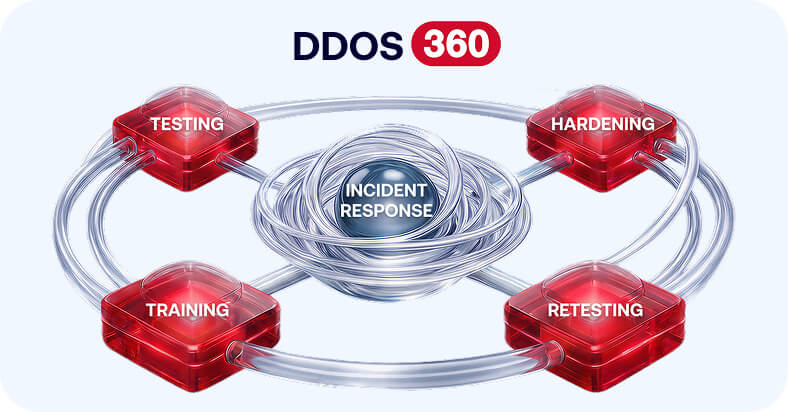
Customers can expect enhanced operational resilience, reduced risk of downtime, regulatory compliance support, actionable insights, cost savings, improved customer trust, and continuous improvement through the DDoS 360 program. Red Button has handled over 30 global DDoS incidents annually, including attacks up to 1.2 Tbps. Note: Impact depends on implementation and ongoing engagement; organizations should review case studies for specific outcomes.

Technical Requirements & Implementation

How long does it take to implement Red Button's DDoS testing services?

The onboarding phase typically takes around two weeks from kickoff to test execution, including scoping, architecture review, test plan drafting, and approval. Customers usually dedicate about five hours: one hour for a pre-test interview, three hours for the live test session, and one hour for results readout and remediation recommendations. Note: Timelines may vary for complex environments or additional third-party approvals.

How easy is it to start using Red Button's services?

Red Button's onboarding is streamlined, requiring minimal customer effort. The expert-led team handles planning, execution, and analysis. Tests can be scheduled during maintenance windows or low-traffic periods to minimize operational impact. Red Button assists with third-party approvals if needed. Note: Some environments may require additional coordination; consult Red Button for specifics.

Security & Compliance

What security and compliance certifications does Red Button hold?

Red Button is ISO 27001 and SOC 2 compliant, providing audit-ready evidence and technical reports to demonstrate disaster recovery readiness and support certification requirements. These certifications help organizations meet stringent regulatory demands. Note: Certification scope may vary; organizations should verify applicability for their specific needs.

Pain Points & Problem Solving

What core problems does Red Button solve for organizations?

Red Button addresses unvalidated DDoS defenses, vulnerability identification, regulatory compliance, operational disruption, overconfidence in existing solutions, continuous improvement needs, and specialized testing requirements for unique environments. 75% of companies fail to mitigate severe DDoS attacks, highlighting the need for realistic testing and ongoing improvement. Note: Best fit for organizations seeking tailored DDoS resilience; generic solutions may not address all pain points.

Customer Proof & Success Stories

Can you share specific case studies or success stories of Red Button customers?

Red Button has worked with organizations such as the European Central Bank, Israeli Bank, Big 4 Accounting Firm, Olympic Games Logistics, and government agencies. For example, the European Central Bank identified gaps in its DDoS protection stack, and an Israeli Bank improved its DDoS Resiliency Score from 3.0 to 4.7 after remediation. Full case studies are available at the case studies page. Note: Results are specific to each customer and environment.

Industry Coverage

What industries are represented in Red Button's case studies?

Industries include financial services, gaming, technology, telecommunications, transportation & logistics, government, and manufacturing. Each case study provides detailed insights into challenges, solutions, and results achieved. See the case studies page for industry-specific examples. Note: Industry coverage is based on published case studies; contact Red Button for additional references.

Case Study: GOVERNMENT

Validating DDoS Resilience for a European Government Agency

Validating DDoS Resilience for a European Government Agency

Government agencies tend to be at a very high risk of DDoS attacks, as they constitute a high-profile target. The IT team of one European government office, therefore, decided to evaluate the effectiveness of its protection measures in relation to DDoS attacks.

The protection architecture used the Azure DDoS IP Protection Plan. The setup involves a DNS resolving user API requests and then routing them to the application gateway and WAF, where they are inspected and filtered. Requests that are not blocked are forwarded to the cloud environment, where an API Management system enforces a custom rate-limiting rule. Permitted requests then proceed to a firewall that blocks all traffic by default, with only explicitly defined ports open. Requests for the ECHO API are then resolved by the API service and requests for a specialized in-house API are routed to an on-premises data center through a VPN for handling by an associated API service.

The Solution

We designed and executed a comprehensive DDoS simulation to assess the efficiency and resilience of the agency’s protective measures. To rigorously challenge Azure’s Web Application Firewall (WAF) and DDoS IP Protection Plan, we launched seven distinct attack scenarios using a globally distributed botnet of 400 bots. These scenarios included both network layer and application layer vectors, ranging from common to advanced techniques.

The simulation was tailored to reflect the organization’s current infrastructure, known threat landscape, and risk profile. The goal was to validate protection controls, identify weak spots, and test incident response – namely, the ability to detect and mitigate real-world threats.

The Results

Of the seven attack scenarios, three were detected and mitigated. One was only partially mitigated and three were not mitigated at all, resulting in service disruptions that affected the agency’s internet-based services. While Azure’s protection services provided a baseline level of defense, our testing revealed several weak points, particularly in detection latency, configuration gaps, and the handling of complex application-layer attacks.

Azure rate limit rules did not work during the simulation, resulting in zero mitigation of attacks targeting the API services. In addition, the DDoS Protection Plan, which should respond to layer 3/4 attacks, did not detect or mitigate a TLS Reconnections attack.

Recommendations

The Red Button team recommended the following measures to improve the government agency’s resilience to DDoS attacks.

  • Contact Azure: In the wake of the rate limit and DDoS IP Protection Plan failures, Azure should be called upon to remediate by analyzing the simulation logs and configuring mitigation policies accordingly.
  • Add a Content Delivery Network (CDN): Implementing a CDN, such as in Azure Front Door, would provide an additional layer of protection at layer 3/4 and against application layer attacks. By leveraging global CDN points of presence (PoPs), the IT team can also enforce rate-limiting rules at the edge, further enhancing security.
  • Fine-tune the rate-limit rules: Rate-limit thresholds should be set to the lowest possible value that maintains normal traffic flow and avoids false positives, based on a thorough review of typical traffic patterns. The thresholds in place during the DDoS simulation were set too high, potentially allowing attackers to launch high-rate attacks.
  • Re-run the DDoS simulation: After applying the aforementioned recommendations, the agency should perform another DDoS simulation to verify that the implemented defenses are effective and working as intended. This follow-up test helps validate the system against the types of attacks previously identified and confirms that no new vulnerabilities were unintentionally introduced.